

Huge conference for laboratory technicians and biomedical laboratory scientists: Networks, intercultural (mis)understanding – and a murder case
250 laboratory technicians and biomedical laboratory scientists from Danish universities left the laboratory for two days to cultivate their professionalism and strengthen their networks. 100 of them and one of the organisers are from AU.

On Tuesday and Wednesday, 100 of AU's approximately 250 laboratory technicians and biomedical laboratory scientists switched off the microscope and hung up their coats to participate in a two-day conference together with 150 laboratory technician colleagues from the country's other universities.
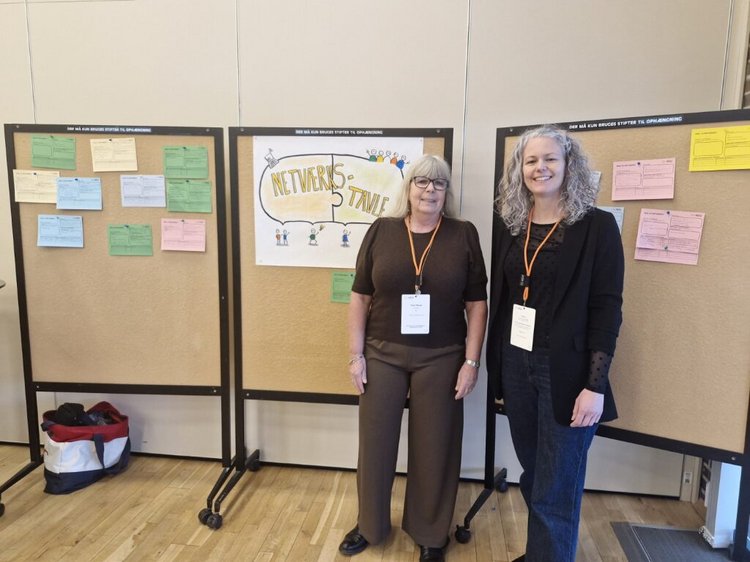
The conference for laboratory technicians and biomedical laboratory scientists in the university sector is held every two years. Trine Ravn-Jonsen is a laboratory technician at the Department of Geoscience and union representative and has helped organise this year's conference together with the previous one in 2024. The day after the conference, she looks back on an event that, in her opinion, went "extremely well".
In addition to professional presentations on, among other things, artificial intelligence in the laboratory and on the laboratory technician education, there was also the opportunity to choose various workshops on sustainability, intercultural understanding, continuing education and quality assurance in the research laboratory. In addition, the conference was a good opportunity to network with colleagues from both AU and other universities, Trine Ravn-Jonsen says.
“Basically, for me, it's about networking and experiencing that we are such a large professional group that has the same conditions and challenges in everyday life.”
That network can be difficult to acquire in everyday life, she says and elaborates:
"At the Department of Geoscience, we are five laboratory technicians, each of whom is very specialised in our field."
Trine Ravn-Jonsen works on a daily basis with analyses of sediments from Greenland and Africa. At the conference, she met laboratory technicians from both AU and other universities who are working on similar projects or using the same methods – and then the seeds have been sown for future collaboration, she says.
"The conference also keeps some relationships alive that I don't get to nurture in everyday life," she says.
ARTIFICIAL INTELLIGENCE AND CULTURAL UNDERSTANDING
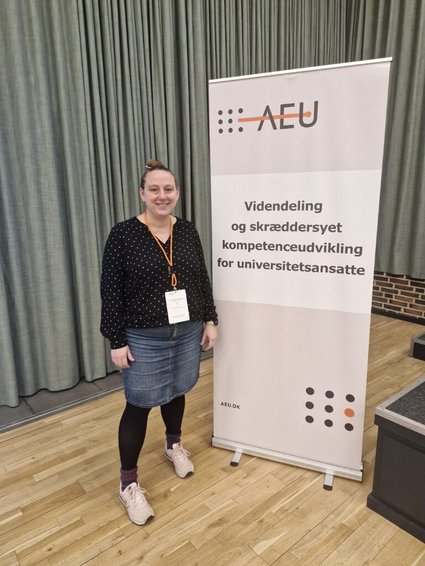
Tina Thane is a laboratory technician at the Department of Environmental Science in Roskilde and participated in the conference for the first time this year.
"It's fantastic to bring together us laboratory technicians and biomedical laboratory scientists, because it's rare that we meet on a daily basis," she says a few days after the conference.
Among the presentations that made a particular impression on her was a presentation from the university colleges about the education of future laboratory technicians and about how the schools seek to prepare students for the labour market. But she was also inspired by a presentation on the use of artificial intelligence in the laboratory:
“It's exciting and something we need to learn, because the technology is also finding its way to the laboratories, where we can use it for chemical risk assessments and comparisons. I got a taste for it.”
A workshop on intercultural understanding and misunderstanding also gave Tina Thane insight and concrete tools to deal with the challenges that can arise in the meeting between people from several different cultures in the laboratory.
"I could hear that we all have the same experiences. We get more researchers, PhD students and students of different backgrounds into our laboratories – and we must be able to understand and communicate with each other despite differences," she says and elaborates on what can be difficult:
"It can be something like humour and everything that is implicit. It was interesting to hear that we have the same challenges – and it was clear that we need to know more about it," she says.
Specific tools
Mette Hoffmann Asmussen, laboratory technician at the Department of Molecular Biology and Genetics, has participated in the conference for all the years it has existed. She also participated in the workshop on intercultural understanding.
"We were together with colleagues from other universities in the country and could see that we have the same challenges. It was both thought-provoking and affirming. I left with many concrete points and tools for looking at conflicts and trying to understand why people act the way they do," she says, citing as an example disagreements about whether to wear coats in the laboratory.
Overall, she praises this year's conference for offering relevant presentations and workshops.
"It sends me home with something I can use professionally, and I met like-minded people in the same boat as myself."
From the Department of Molecular Biology and Genetics, a total of 12 laboratory technicians were present. The costs associated with participation in the conference are shared equally between the department and the research group, says Mette Hoffmann Asmussen.
SOME RESEARCH CLIMATE, OTHERS SHED LIGHT ON MURDER CASES
As the organiser, Trine Ravn-Jonsen is pleased with the great support that has been given to the conference this year, both from colleagues and from department heads.
"It inspires me that there are so many of us. And I am honestly impressed by how skilled, enterprising, positive and supportive we are as a professional group."
For Trine Ravn-Jonsen, the two days at the conference also provide an opportunity to raise her eyes from the sediment cores and reflect on her professionalism.
"When we graduate, we are generalists, but after working at the university for a few years, you become specialised in your own small field. At the conference, I was reminded of the basic knowledge I have as a laboratory technician – I can quality assure and create structure and rigor."
The conference also gave her an inspiring insight into what laboratory technicians are doing elsewhere in the university sector. While she herself sits with sediments of soil and seabed and supports research into the climate of the past, some of her colleagues are helping to save lives and solve murder cases, she says, referring to a presentation at the conference with Professor Michael Toft Overgaard from the Faculty of Engineering and Science at Aalborg University. Together with his research group, he has contributed with analyses that played a crucial role in an Australian murder case. Here, Kathleen Folbigg was found guilty in 2003 of killing her four children, she herself maintained that she was innocent. With the help of Michael Toft Overgaard's research group, among others, it was possible to establish with a high probability that the children had rare genetic defects and mutations that could lead to death. In 2023, Kathleen Folbigg was pardoned and subsequently had her sentence annulled.
This text is machine translated and post-edited by Lisa Enevoldsen.