

Aarhus University expects large surplus for the third year in a row
AU expects to close 2025 with a surplus of DKK 268 million. Both the operations and the financials produce larger profits than budgeted. That leaves a solid economy that also provides leeway for strategic investments, explains the university director. Economics professor questions the large surplus for the third consecutive year.

For the third year in a row, it seems that Aarhus University will make a significant profit. The AU expects to emerge from 2025 with a surplus of DKK 268 million against a budgeted surplus of DKK 103 million. This is shown by Financial Report 3, embedded in the 2026-2029 budget, which The Board has just approved at a December 11 board meeting.
After the large deficit of DKK 292 million in 2022, the university has since enjoyed significant profits every year. In 2023, the result ended at DKK 262 million, the profit in 2024 amounted to DKK 184 million, and 2025 now looks set to follow the same trend.
University Director Kristian Thorn is pleased with the expected result, which he calls solid, and with the economic outlook for the coming years. He elaborates that the large surplus is due to several factors.
“We had budgeted with a surplus because we expected the surplus on financial items to help rebuild equity, which is below our target of 10 percent. It has then become larger than expected, but it is very much part of the picture that there are expenses that we expected to have in 2025, which will not come until 2026 and 2027,” says Kristian Thorn.
DKK 188 million in operating profit
Here, he points out, among other things, the expenses related to relocating Aarhus BSS’s facilities from Fuglesangs Allé to Universitetsbyen and the development of AU’s campus in Viborg. In addition, in 2025 there has been a smaller increase in wages than expected, but as of November the salary has been adjusted so that it equalizes next year. The surplus is also due to the fact that AU has once again secured and spent a historically high amount of external research funding this year.
“The reality has surpassed our high expectations for consumption. We have gone from budgeting with a consumption of external funds of DKK 3.2 billion to now spending DKK 3.4 billion,” says Kristian Thorn.
The operating profit, i.e. before financial items, which are returns from the university's investments in stocks and bonds, is expected to be DKK 188 million, according to ØR3.
Equity is expected to rise slightly to 8.6 per cent of the university's total revenue. Here, AU's target is to be at 10 percent, which the university expects to hit by 2026. In fact, AU is budgeting with equity rising in the coming years, hitting 12.1 per cent by 2029. That is more than the target and more than the 11 per cent recently set by the board as a cap on how much equity maximum should make up of turnover. This places AU in a favorable financial position, and the 2026–2029 budget also notes that towards 2029, there will be financial leeway that is not allocated in the budget.
Economist: “Misbudgeting”
As mentioned earlier, it is now the third year in a row that AU has made a large profit. At the same time, the surpluses each year are somewhat larger than AU has budgeted for. In 2023, the university budgeted with a surplus of DKK 9 million, which ended up with a surplus of DKK 262 million. In 2024, it budgeted with a surplus of DKK 48 million, which ended with a plus of DKK 184 million. And this year, the profit looks set to be DKK 268 million, which is DKK 165 million more than budgeted when the university went into 2025.
Immediately, one might think, it is difficult to be dissatisfied with a surplus. But Professor of Economics at Aarhus University Christian Bjørnskov nevertheless “wonders” that a university, which is a public organisation, has been running at such large profits for several years in a row.
“It may be a good idea in a period of consolidation, but AU is not in it. There is, for good reasons, a big deficit in 2022, but it will take a year to pick it up again. And then, in principle, no more consolidation of the economy is needed,” says Christian Bjørnskov.
Christian Bjørnskov wrote a column in Børsen in August titled “What does the state spend the public surplus on?” . Here he points out that the Danish public sector has a huge surplus, and while that may sound good, it is “a rather absurd situation for economists” as the public accounts should, in the long run, balance out, he writes. Now, the state and the university are two different sizes, but according to Christian Bjørnskov, it may be relevant to ask the same question here. How does the university prioritize its funds?
One might also question why the AU has budgeted in recent years with surpluses that are so much smaller than it has ended up with.
“In a political sense, I can understand that they say it was good (with a larger profit than expected, ed. ). But for an economist, that's not good news. To them, it is simply a sign of misbudgeting,” he says, referring to his column:
“This is also part of the background for the Børsen column I wrote, because a lot of people saw the very large surpluse on the Danish public finances as a good thing. But that's not the case for us as economists,” says Christian Bjørnskov.
University Director: “We try to hit the budget as accurately as possible”
According to the University Director, what Christian Bjørnskov calls misbudgeting, this year is due in particular to the period shift in spending to 2026 and 2027 and the greater consumption of external research funds. For 2023 and 2024, it is in particular the return on the university's investments that has driven the high profits and, in part, the high consumption of external research funds.
Kristian Thorn acknowledges that the results over the past few years have been much better than expected, and that they have also been pleasantly surprised.
“We try to hit the budget as accurately as possible. And we are in close dialogue with the faculties. But I would also like to say — and this can be called misbudgeting — but we have been pleasantly surprised by the consumption of external research funds,” says Kristian Thorn.
“The goal is not to hoard money”
Kristian Thorn explains that Aarhus University is not simply hoarding money, nor is that the goal. The profits that have been generated are being spent on investments in the university, he stresses. This is currently happening and will continue in the coming years with more offensive investments in campus development and a number of initiatives from AU's 2030 Strategy focusing on, among other things, the study environment, cybersecurity, strengthened innovation efforts, sustainability and young research talents. He believes staff and students will feel that widely.
“Our equity is not going through the ceiling. On the contrary, we are below our objective for unbound equity, and the reason for this is that we are continuously investing in the university,” says Kristian Thorn.
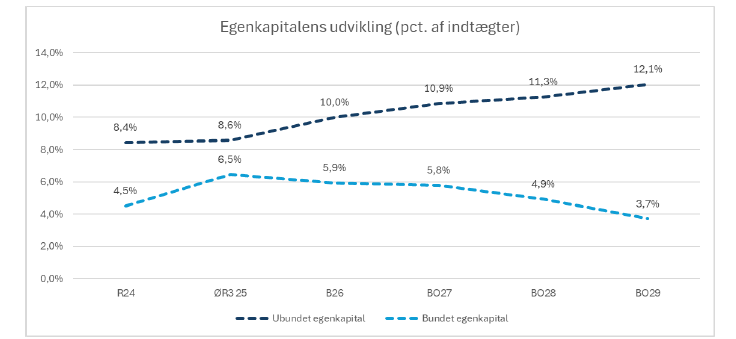
Unrestricted and restricted equity:
In October 2024, AU's Board decided that AU's equity would henceforth be presented as a restricted and unrestricted portion of the equity.
The objective that equity should amount to 10 percent of the university’s revenue relates to the unrestricted portion of the equity.
The restricted portion of the equity represents funds that the university has earmarked for various initiatives, such as campus development. The restricted equity will partly be drawn down through the university’s initiatives in the coming years, while the unrestricted equity is expected to increase.
If the equity gets too big, the money has to be spent, he notes.
“There are clear limits to our reserve and this is something we are following closely. Where it has so far been the case that equity could be at a maximum of 12.5 per cent of turnover, the board has recently decided that the cap is at 11 per cent. If we get over our target, it will trigger a discussion on how we can invest further in the university,” says Kristian Thorn.
Profits again in the coming years
The university director notes that it is important to distinguish between operations and financial items. The return on financial items helps to increase equity, but operations must be able to stand on their own. Operations must be in balance, and the university is also budgeting for this to be the case in the coming years.
The AU is budgeting for a surplus of DKK 127 million next year and DKK 110 million in 2027. After that, the university expects two years of deficits. But Kristian Thorn stresses that operations are structurally in balance because the projected deficits in 2028 and 2029 stem from the planned investments that come from savings, but which affect the annual result.
“When we draw on our reserves, it shows up as negative results, but that does not indicate that we are creating an imbalance in AU’s overall finances. The operating accounts are still in balance. That's a really important message, because otherwise you might get worried when you look at it and think, 'Oh, hold on, it's going really well, and it's actually going downhill from there.' That’s not the case. It is a fully planned investment in our campus development, which is reserved on the so-called restricted equity,” says Kristian Thorn.
In the longer term, the goal for him as university director is to have an operation in balance, he stresses.
“AU must use the money entrusted to the university by society to create research, education and innovation. That's our purpose. We are not put in the world to generate a profit. There are two important considerations for ensuring a healthy economy: One is that AU would like to have a balanced operating budget, and another is that we can withstand external shocks with a reserve of 10 percent of revenue. And if we are below our equity target, we build it up through income from interest on our liquidity or, ultimately, a small surplus in some years,” says Kristian Thorn.
This text is machine translated and post-edited by Louis Beck Petersen.