
Rector's wish list: More international students and better rail connections to the capital
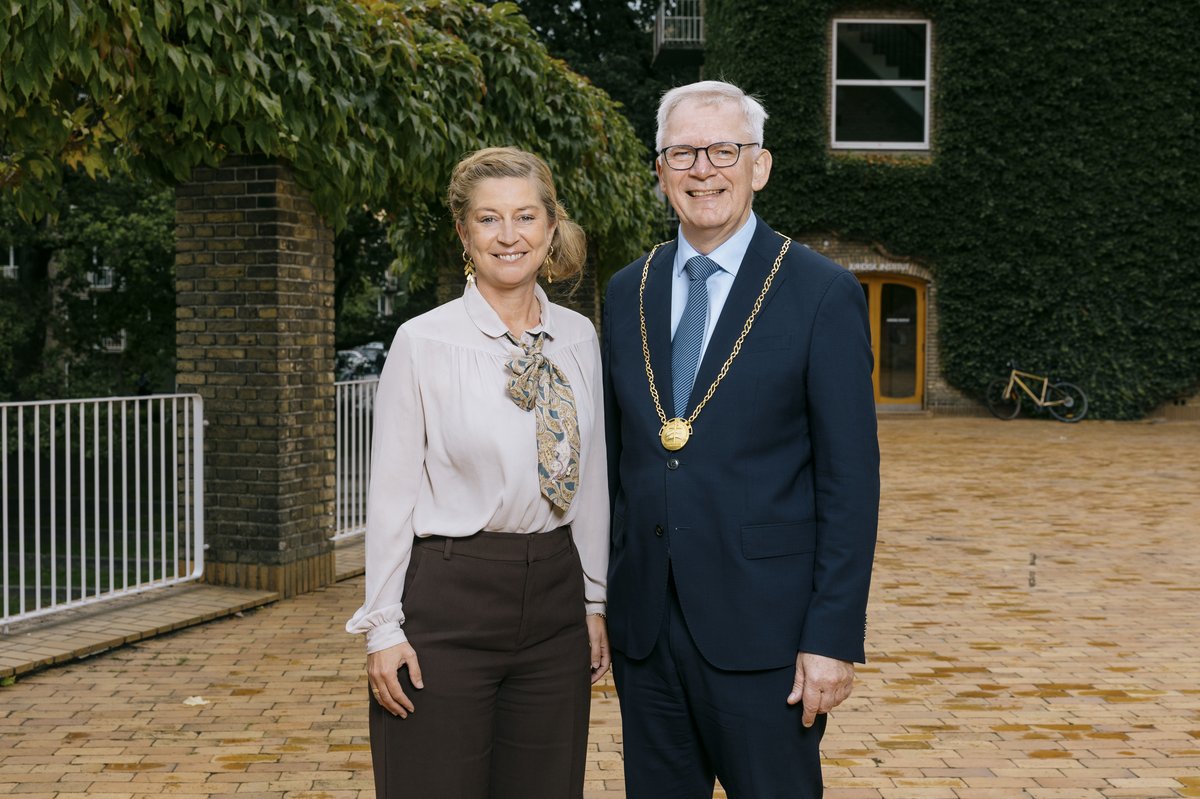
Aarhus University celebrated its 98th birthday on Friday, and Rector Brian Bech Nielsen brought a wish list for the minister, who sat in the front row at the annual celebration.

Awards presented at the annual celebration
AU’s 2026 distinguished alumna: Helle Østergaard Kristiansen, senior vice president for Gas & Power, Equinor, holds a Master of Science in Business Economics and Auditing from the Aarhus School of Business.
Rigmor and Carl Holst-Knudsen Award for Scientific Research: Ivan Bjerre Damgård, professor at the Department of Computer Science
The Vibeke Borchsenius Award (teaching award): Ulla Kidmose, associate professor at the Department of Food Science
Else Kai Sass Award (research communication award): Stine Slotsbo, senior researcher at the Department of Ecoscience
Recipients of Queen Margrethe II’s travel grant:
- Emil Klitgaard Alslev (Arts)
- Molly Guldfeldt Madsen (Aarhus BSS)
- Signe Klitgaard Bitsch (Health)
- Josephine Samantha Nielsen (Nat)
- Phillip Ferreira Baade-Pedersen (Tech)
Honorary doctorates:
- Karen River Barad, professor at the University of California (Arts)
- Nicolai J. Foss, professor at Copenhagen Business School (Aarhus BSS)
- Joy Elizabeth Lawn, professor at the London School of Hygiene & Tropical Medicine (Health)
- Anne L’Huillier, professor at Lund University (Nat)
- Arthur P.J. Mol, professor at Wageningen University (Tech)
Aarhus University celebrated its 98th anniversary on Friday with the traditional annual celebration in the Main Hall. In her address, Chair of the Board Birgitte Nauntofte emphasised that today we celebrate an institution that fully lives up to its mission, continually developing its campuses and study environment while contributing to society through knowledge, skilled graduates, and research-based innovation. But she assured the audience that the 98-year-old institution has no plans to sit back and rest on its laurels.
“We are not finished at all; we have only just begun. The university sector has long called for non-earmarked innovation funding, and we received it in 2026,” said Birgitte Nauntofte, explicitly thanking Minister of Science, Higher Education and Digital Affairs Christina Egelund (M), who attended the annual celebration.
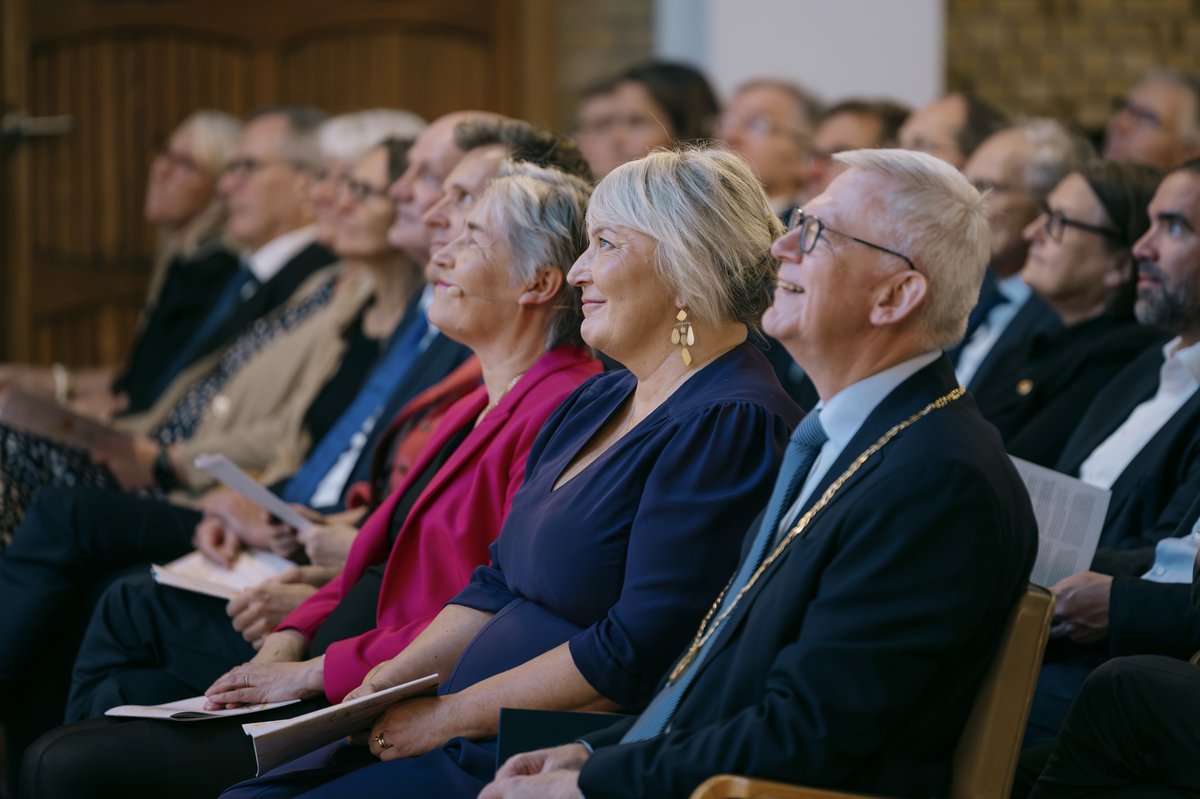
“It is not enough simply to express our gratitude; we must also deliver,” said Nauntofte. According to the Chair of the Board, a good place to start is by bringing together the right people. In this regard, she highlighted last year’s appointment of seven so-called AU Distinguished Senior Innovators, experienced researchers who are to devote their time to a combination of research and innovation.
“When we gather here again next year, I can promise you that we will have recruited more than 50 additional people to similar positions. By then, we will also have appointed a new pro-rector for Research and Innovation, ensuring a coordinated leadership structure across the university. And there is more to come, because Denmark and Europe are in great need of a stronger link between research and innovation,” she said, before turning to another area where, according to the Chair of the Board, the university needs to step up its efforts: artificial intelligence.
“When it comes to AI, there are tremendous global forces at play, both politically and economically. It is easy to become paralysed by the scale of it. But I try to remind myself of a quote by the American architect Buckminster Fuller: We are called to be the architects of the future, not its victims.”
She made it clear that universities will be essential to that development:
“Artificial intelligence is one of those cases where the tool has arrived before the wisdom required to use it. Research must help to close this gap – to the extent that it can.
Rector's wish list
While the Chair of the Board outlined what society can expect from Aarhus University in the years ahead, Rector Brian Bech Nielsen had prepared a wish list for the politicians. However, he also thanked the minister for last year’s political boost to the universities’ basis funding, which this year was supplemented by entirely new basis funding for innovation. Both have long been on the university's wish list. But the rector also made it clear that there are still items left on the list. One of those wishes is for Aarhus University to be allowed to admit more international students.
“It is unsustainable that Aarhus University today has by far the lowest share of English-taught degree places of any university in Denmark. So our wish is both modest and fair: “We simply need to be brought up to a level that matches the sector average,” said the rector, before turning to the next item on the wish list: Better infrastructure to and from Aarhus.
The rail connections to the capital and Hamburg are, quite frankly, a disgrace.
“Aarhus is a magical, fantastic place, most people agree. But most people also agree that it can be difficult to get to and from the city. The nearest airport is not exactly well connected to international hubs, and the rail connections to the capital and Hamburg are, quite frankly, a disgrace,” said Brian Bech Nielsen.
The rector acknowledged that this is neither the fault of the current nor the previous government:
"It is the result of 30-40 years of neglect, but the responsibility lies with the current government," he stated, calling for a quick, direct and, not least, reliable connection to the capital and then to the rest of Europe.
“We simply need to get back on track.”
Strengthen engagement
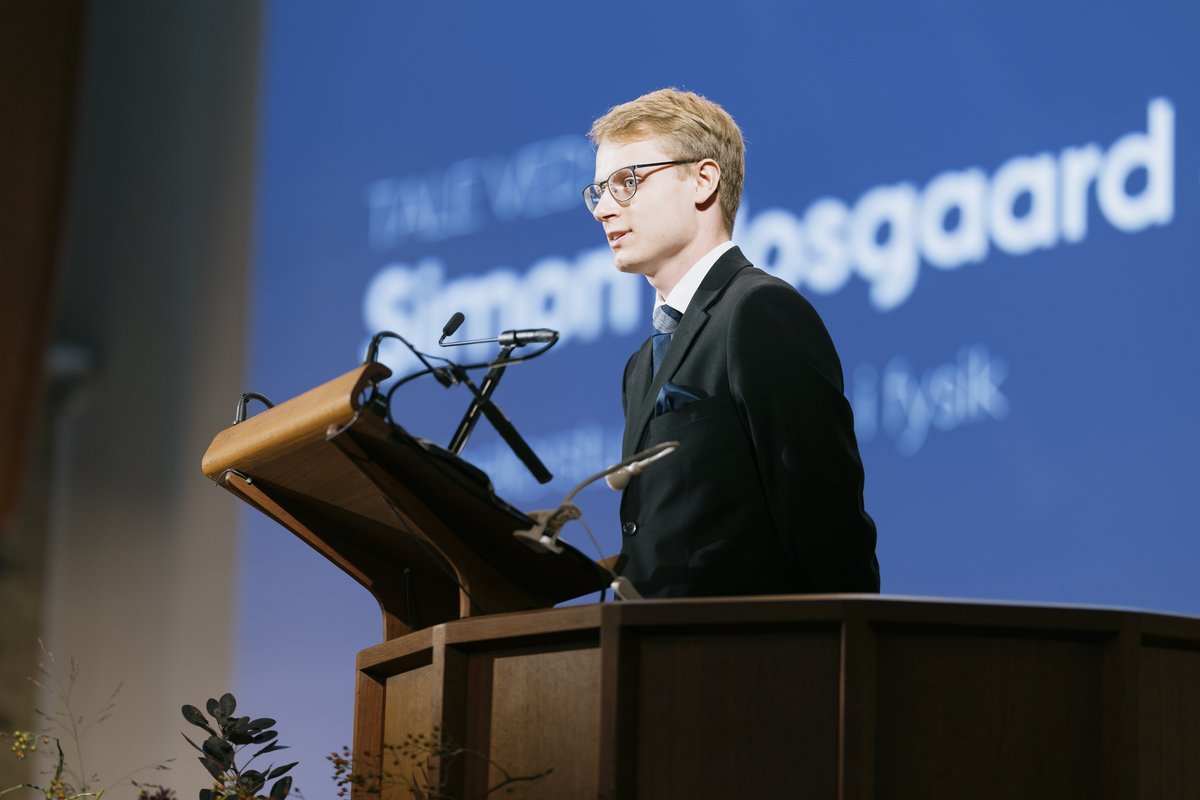
This year's student speaker, Simon Mosgaard Jørgensen, who is studying for a Bachelor’s degree in physics, also brought a wish list addressed to the university leadership. He presented three proposals meant to increase students' opportunities and desire to get involved in the university's councils and boards.
However, he began by emphasising that Aarhus University has a strong tradition of involving students in decisions that affect their education and student life. However, he pointed out that many councils and boards struggle to attract student engagement, despite offering students a direct voice in decisions. He noted that some academic councils still have unfilled student seats, while some boards of studies lack student representation altogether.
Without student involvement, Aarhus University would be a worse place to study.
“Students’ perspectives, knowledge and experiences are essential to making the university better. Without student involvement, Aarhus University would be a worse place to study, and that is a problem. We therefore need to strengthen student engagement, which makes recruitment to academic councils and boards of studies all the more important. When there is no competition for seats, and even more so when positions remain vacant, the elections and the work carried out by these bodies are seen as less important. As a result, it becomes harder to persuade students to stand for election.”
The three proposals are: Students must understand the decisions that are made and the tasks that are carried out in the respective councils and boards. Participation in councils and boards must be made easier by ensuring, for example, that it does not conflict with students’ academic commitments and that the administrative support provided to these bodies is efficient and effective. Finally, he proposes that the university broaden student participation by including students in a wider range of committees, such as local occupational health and safety committees and Aarhus University’s education and departmental forums.
“It may sound contradictory to want more committees when the ones that exist now cannot be filled. But different tasks attract different people, and so I think it will be easier to recruit if we offer more options," he said.
A living legend
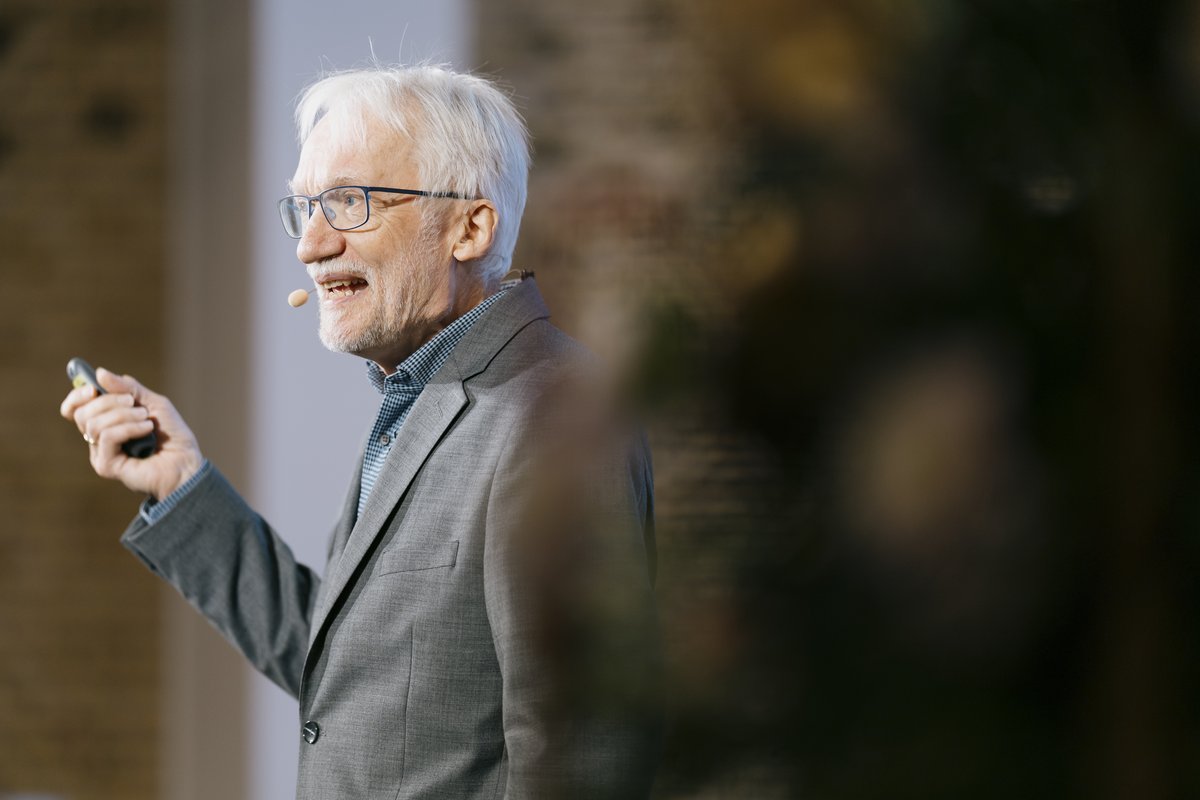
As is tradition, awards and honours were also presented at the annual celebration. Dean of Natural Sciences, Birgit Schiøtt, presented this year's recipient of the Rigmor and Carl Holst-Knudsen Award for Scientific Research as nothing less than a "living legend".
For more than 40 years, Professor Ivan Bjerre Damgård of the Department of Computer Science has worked in the field of cryptology and explored how digital data can be exchanged securely.
“Today, the need for digital security has exploded, but you and your colleagues were so far ahead of your time that you had the technology for data security in place long before the rest of the world even discovered that it was necessary,” said Birgit Schiøtt.
“Universities are more important than ever”
Ivan Bjerre Damgård also delivered this year’s celebration speech, in which he discussed not only cryptology but also the role of basic research and a future shaped by artificial intelligence. And when it comes from a discipline that saw the need for cybersecurity long before the rest of us had moved on from payment slips, school contact books, and carbon paper, people tend to sit up and listen:
“Some will say: “Now AI is coming in and taking over everything, so we no longer need to think for ourselves. I would argue that the exact opposite is true. It is more important than ever that we think for ourselves. The idea that this development comes rolling in and that there is nothing we can do about it is an illusion. It is technology designed by humans. It is people who decide what it should and should not be used for. “So, of course, we can shape the future,” he said, stressing that this requires us to understand what is going on around us.
“The knowledge that people possess is more important than ever – and from that, I think it logically follows that universities are more important than ever.”
But change is inevitable, he says.
“I don't imagine that everything will continue to be the way it was. I imagine that, in the near future, we will be working in a completely different way than we have in the past. In fact, that is already happening now. But it need not become any less interesting, provided we are willing to keep thinking for ourselves.”
This text is machine translated and post-edited by Mie Skov Jeppesen.