

Background checks: Aarhus University has rejected 89 applicants
Since 2024, Aarhus University has carried out background checks on 945 applicants from countries including China, Iran and Russia. Of these, 89 applicants have been rejected. Across faculties, there is a big difference in how many applicants are screened. And AU is now also introducing stricter guidelines at certain departments.

Since 2024, Aarhus University has carried out 945 background checks in connection with recruitment processes, guest invitations and PhD enrolment involving applicants from abroad. The individuals who have been screened are applicants from countries that the Danish Security and Intelligence Service, PET, characterises as 'high-risk countries', including China, Russia and Iran. Based on this screening, the university has rejected 89 individuals, which is just over nine per cent of those screened. This is according to figures from Aarhus University, which Omnibus has gained insight into.
The background checks are one of the initiatives that Aarhus University has introduced to meet several recommendations from the so-called URIS committee (Committee on guidelines for international research and innovation collaboration, ed.), which was established in 2020 under the former Ministry of Higher Education and Research. The purpose of background checks and the other URIS initiatives at AU is to protect the knowledge held at the university.
“The primary aim is not to catch spies, but to prevent employees from being bribed or coerced into disclosing information they gain through their work at AU,” says Brian Vinter, vice-dean for Research at the Faculty of Technical Sciences and chair of AU's implementation of URIS guidelines.
He emphasises that this does not only apply to citizens from high-risk countries and mentions that there are a few examples of cases outside AU that have involved Danish citizens.
“All employees can be bribed or blackmailed, but some are unfortunately at higher risk than others,” says Brian Vinter, explaining what AU looks at when the university screens applicants.
“We look at how visible the applicant is to their regime at home – that is, does the regime know that they exist? In addition, we look at whether they are employed by a university that has close ties to the military in the regime in question, as is the case for several universities in China, for example,” explains Brian Vinter.
The concern is not that specific research results will be leaked, but rather that sensitive information that employees gain access to through their work at the university will fall into the wrong hands, Brian Vinter explains:
“This could be confidential information that should not be released, such as knowledge about the electricity grid and where high-voltage lines are located. It could also be certain fields within biochemistry that have dual-use, where our use is civilian, but where there can also be military use," he cites as examples.
The fact that it is primarily applicants from China, Iran, and Russia who are screened is due to recommendations and threat assessments from PET, Brian Vinter states.
“The university does not conduct foreign policy; we follow the instructions of the authorities.”
Of the screened applicants, over half were from China, and almost a third were from Iran. The nationality of the rejected applicants is not apparent from the figures Omnibus has been given access to.
Differences in faculties
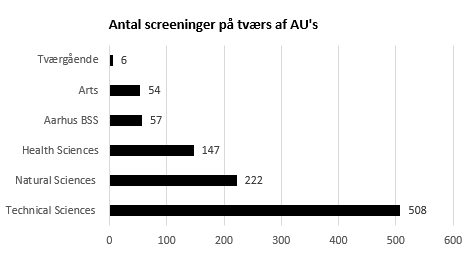
There is a big difference in how the number of background checks is distributed among AU's five faculties. Technical Sciences is the faculty that conducts the vast majority of background checks, followed by Natural Sciences and Health Sciences, while Aarhus BSS and Arts are at the bottom.
This difference is partly due to the fact that the number of critical research areas varies between faculties.
Stricter guidelines for certain departments
Aarhus University has also introduced stricter guidelines for screening this year, which apply to certain departments that have many of the critical research fields. For other departments, the stricter guidelines will only apply within selected research areas.
"Where stricter guidelines have been introduced, the basic principle is that all applicants must be screened unless they come from pre-approved countries," explains Brian Vinter, and states that AU receives advice from a number of authorities, which, in addition to the EU, include PET, the Ministry of Foreign Affairs of Denmark, and the Ministry of Industry, Business and Financial Affairs. The pre-approved countries are EU countries, Australia, Canada, Iceland, Japan, New Zealand, Norway, Switzerland, Liechtenstein, the United Kingdom, and the United States.
In addition, Aarhus University is also beginning to micro-segment IT networks – that is, the university is limiting employees' network access to the networks that are necessary for the employees to perform their work.
“We start at the Department of Electrical and Computer Engineering, which is one of the heavy departments in the URIS context. Here, employees will have general IT access and will, in addition, only be granted access to the specific group or groups they work under. We micro-segment our network to protect both research and employees. This measure is not part of the URIS guidelines, but is about protecting against industrial espionage," says Brian Vinter, and continues:
“However, with regard to URIS, it has the advantage that we will no longer need to reject as many applicants,” he continues.
Specialised unit trained by PET
At Aarhus University, a specialised unit within Nat-Tech’s HR department carries out all background checks, regardless of which faculty the application is directed towards. The unit works exclusively with open sources, but has received training from PET and is part of a pan-European collaboration, Brian Vinter says.
“They look at information such as the applicant's educational background, affiliation with universities, who they have published with, which projects and research areas they have been a part of,” he says.
The screening takes place early in the application process, before candidates are selected for an interview. Therefore, individual applicants do not know whether they have been subject to a background check. However, when they apply for the position, they are informed that background checks may occur.
If an applicant receives the status of 'rejected' after the screening, it means that concerns and risk factors have been identified.
“It is the head of department who assesses how much weight should be given to the identified concerns and risk factors for each applicant when candidates are selected for interview. So far, however, no one has objected to a screening," says Brian Vinter.
AU has carried out the most background checks
Ingeniøren has conducted a survey (In Danish, ed.) of Danish universities, and it appears that Aarhus University is the university that has conducted the most background checks. Overall, according to Ingeniøren's survey, the universities have conducted almost 2.000 background checks. Aarhus University is the only university to have disclosed how many applicants they have rejected.
However, there are differences in how the universities have reported the number of screenings. For example, Aalborg University has provided the number of screenings since 2023, while the University of Copenhagen has provided the number of screenings in 2025. As a result, the figures are difficult to compare.
Brian Vinter says of Aarhus University’s approach that “AU has developed an approach that allows the senior management team to stand by the requirements imposed on the university, ensuring that the URIS guidelines are complied with.”
“We have become good at recognising when some employees are vulnerable (to pressure from their regimes, ed.) and when there is less cause for concern.”
This text is machine translated and post-edited by Mie Skov Jeppesen.