

Fire protection has been inadequate for more than 20 years
No one has ensured that the fire safety in the Nobel Park has been up to standard since the students moved in more than two decades ago.

Send us a tip
If you have doubts about the fire safety where you study or work at Aarhus University, contact us at omnibus@au.dk.
These are the regulations:
Section 17 of the Danish Building Act
“It is the responsibility of the owner of a property at any given time to rectify any conditions that are in violation of this Act or the regulations issued pursuant to it. If the violation consists of an unlawful use of the property, this obligation also applies to the user.”
Source: The Danish Building Act
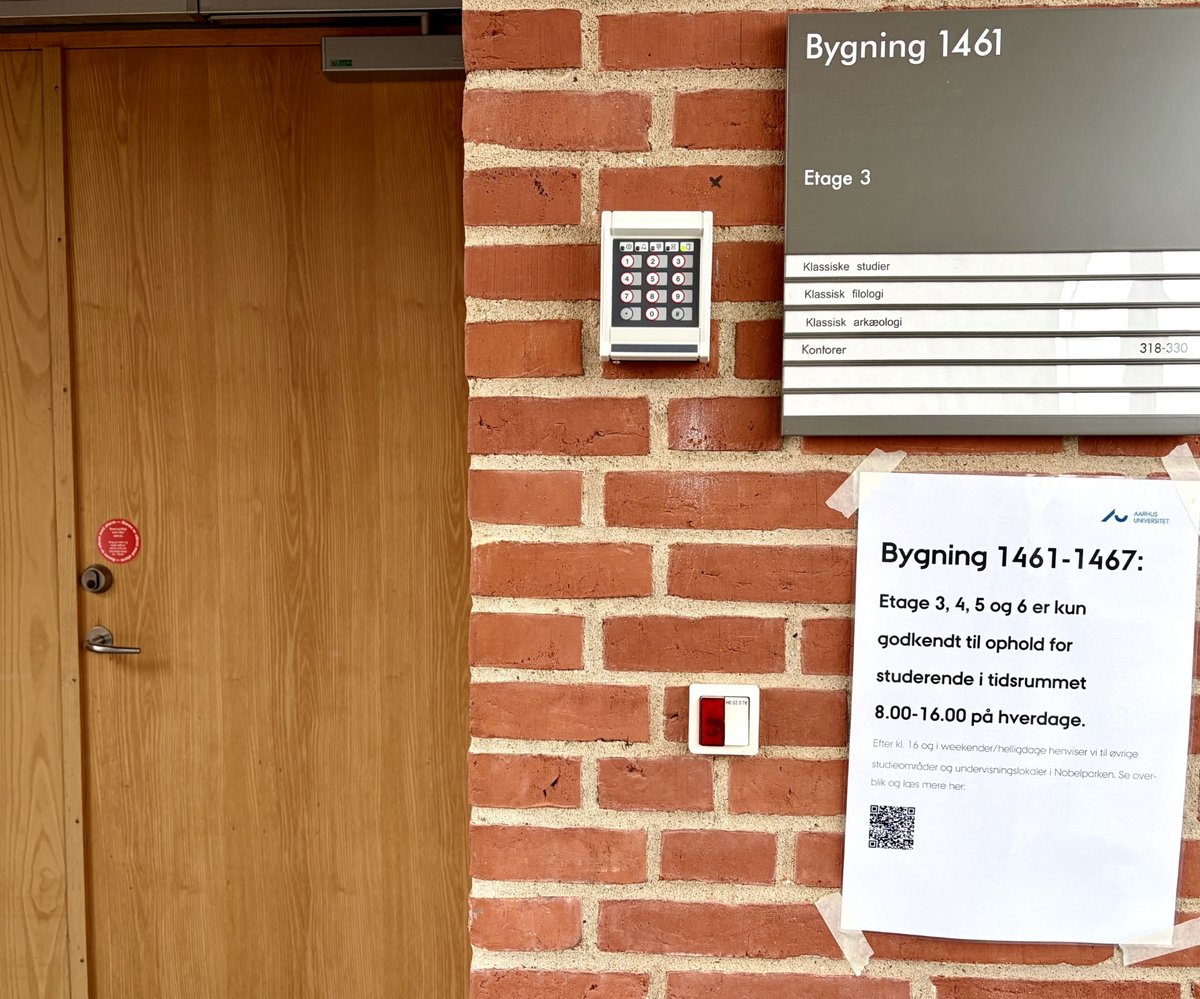
It came as a surprise to everyone when, in late February, students in four buildings in Nobel Park were suddenly sent home due to lack of fire protection.
While working to get approval to expand the capacity of a room from 25 to 30 people, it occurred to the faculty administration at Arts that something was completely wrong. The fire protection was simply inadequate.
Inadequate fire protection in four buildings in Nobel Park sends students home
“We were made aware that from the third floor up, there should be no more than 25 people on one floor. This has always been the case, but when it has been overlooked, I don't know,” vice-dean for education at Arts, Niels Lehmann, explained to Omnibus.
After a few weeks of online teaching, on March 9 students were able to return to their classrooms between 8 a.m. and 4 p.m. on weekdays, because during the rest of the semester, physical fire guards replace the lack of fire warning in the buildings.
But how can this happen?
But how can it happen that for over 20 years, since students moved into the buildings in the early 00's, you haven’t ensured that fire safety is in order?
“We must acknowledge that the procedures Arts has had and followed have not been sufficient. We deeply regret this and will, of course, revise our procedures now that we have become aware that something is not in order,” says Ulla Gjørling, administrative centre head at Arts, who took up the post on 1 January.
Aarhus University doesn’t own the four buildings in Nobel Park. The owner is ‘Forskningsfondens Ejendomsselskab A/S’ (the Research Foundation’s Property Company) commonly referred to as FEAS.
Administrative centre head Ulla Gjørling refers to the lease agreement between AU (Arts) and FEAS.
“We are renting the buildings with the intention of using them for administration, research and education,” Ulla Gjørling explains.
But that is far from the same as all rooms in the entire building being automatically approved for these purposes. This is explained by the building permit officer in Aarhus Municipality, Dennis Bech.
Aarhus Municipality is the one giving permission to change the usage or number of people in a room.
“This is a classic problem. The tenant believes that the entire building has been approved for the purposes one wants to use it for. But every single room requires approval for the specific use. Many people also overlook this when they decide to use a room for something other than what it’s approved for,” Dennis Bech says and continues:
“That’s why we also encourage you to periodically review all your premises to see if you actually have the correct approvals, among other things, with regard to fire.”
No one has done anything
The administration at Arts informs Omnibus that it is impossible to determine what has taken place where in the buildings and when.
In any case, for two decades there has been no focus on whether the individual rooms had the correct approvals, nor has there been any routine inspection of the rooms, even though the authorities encourage such.
“It’s absolutely necessary for us to correct what doesn’t follow the guidelines of the authorities. We can't live with anything else. Therefore, we in the management team took the necessary measures as soon as we became aware of activities that didn’t comply with the existing approvals for the buildings,” says Ulla Gjørling, administrative centre head at Arts.
Where does the responsibility lie?
Ultimately, according to Section 17 (1) of the Danish Building Act, the owner is responsible for ensuring that a building is used in accordance with the granted approvals.
The affected buildings in Nobel Park are owned, as mentioned, by FEAS.
Søren Østergaard, head of building services at FEAS, acknowledges that it’s up to FEAS to ensure the legality of what takes place in the buildings, but he also states that they always require that conditions are in order.
“In general, whenever AU wants to redo something in FEAS buildings, they are responsible for ensuring that it is done in accordance with the applicable regulatory requirements, including fire conditions. You always have to ask us when it is our buildings, and we will always demand that the permits are in order,” Søren Østergaard says.
No good explanation
However, the head of building services cannot offhand offer a good explanation as to why this has apparently not happened in relation to the premises at Arts, nor can he answer why the inadequate fire protection has not been discovered until now.
“To begin with, we have agreed to bring the fire safety up to standard so that the buildings can be used safely. We have agreed to address the underlying reasons afterwards. We’ve promised each other that we will find out what happened so we can prevent it from happening again,” Søren Østergaard says.
Could’ve been discovered earlier
What remains is that the buildings and rooms have lacked the legally required fire safety, despite the fact that numerous changes in the use of the rooms have taken place over the past two decades across the 24 floors spread across the four buildings in the Nobel Park.
But it has apparently not been part of the procedure at Arts to seek permission in relation to changes to the use of the premises.
If permission had been sought to change the use or occupancy load, FEAS would have required that the necessary permits were in place, according to the head of building services. And had Aarhus Municipality been consulted, the problem would very likely have been discovered earlier.
“I’ve looked in our archive and I can only find two previous approvals that have been granted since the building permit in 1999. But it’s also not the case that, as the building authority, we go through the archive in minute detail in such a case. We will always focus on solving the problem,” says Dennis Bech, building permit officer in Aarhus Municipality.
“Consultant must have discovered it”
The work to get approval to increase the number of people in a room from 25 to 30 was done in collaboration with a private fire safety consultant, says Ulla Gjørling, administrative centre head at Arts. And even before the application reached building permit officer Dennis Bech, the case had grown considerably.
“At the time when the university approaches us, they already know there’s a problem. They approach with an application for a permanent solution, but also with the desire to find an urgent solution, to the problem that has arisen,” Dennis Bech says.
“It must have been the private fire safety consultant who discovered that only 25 people are allowed on each floor,” he continues.
A fire safety consultant is a professional with specialist knowledge in the field of fire safety and fire technical documentation. The fire safety consultant’s task is to ensure that buildings and structures comply with the applicable fire safety regulations, including the requirements of the building code and related standards.
Arts hired a fire safety consultant from the company Jensen Hughes, which works globally with, among other things, consulting in fire protection, but he doesn’t want to comment to Omnibus on the matter. Therefore, it hasn’t been possible to verify or deny whether it was the consultant who discovered that only 25 people are allowed on each floor.
A Fire Safety Consultant Can Help
According to building permit officer Dennis Bech, there’s a difference between when a change in the occupancy of a room requires an approval.
But in this case, it’s completely incontestable. For that reason alone that you apply for permission to have 30 people in a room on a floor where only 25 people are allowed in total.
The fact remains that fire safety in the four buildings has not been properly managed since the early 2000s. This is despite the fact that students have had teaching, group rooms and Friday bars for two decades.
“What really makes a difference is teaming up with a private fire safety consultant. Get help from someone who knows something about this. Otherwise, you risk losing knowledge when someone in your organisation gets a new job, for example,” says Dennis Bech from Aarhus Municipality.
From one room to four floors
What began as a desire to increase the the occupancy load of a room from 25 people to 30 led to an application to raise the occupancy load of 24 floors in four different buildings. In addition, there is a zoned alarm system that ensures everyone can be alerted correctly in the event of a fire.
In addition to the extensive application to put everything in order, Arts faced an acute problem and students who had been sent home.
Fortunately, Aarhus Municipality responded positively to the request from Arts and was able to grant permission for the students to return to the buildings.
The regulations say:
Building Regulations Section 6 (i)
“The municipal council may grant a building permit for the holding of temporary indoor events in buildings or building sections that are not approved for such use, provided that the temporary indoor event involves no more than 1,000 people present at the same time. Permission for such temporary events may be granted in a building or building section for a maximum of 50 days within the same calendar year.”
Source: The Danish Building Regulations
In practice, the temporary permit means that physical fire guards will be stationed on all affected floors of the four buildings on weekdays from 8 a.m. to 4 p.m. until May 21.
“This is an approval that is used regularly. It’s mostly used for events where for shorter periods of time you need to be more than the rules attribute. It can be a conference or a debate where you can get permission to put in physical fire guards,” says building permit officer Dennis Bech.
When the approval can also be used for teaching, it’s because students, like participants at a one-off event, cannot be expected to know the procedures for an evacuation in individual classrooms.
Responsibility and bill will be determined later
While the physical fire guards ensure that teaching can continue and FEAS works to get the correct fire warning system installed, the administration at Arts is also busy.
“We can't do anything about the past. But we need to do something now. And that’s just what we’re doing. We are currently reviewing all the buildings at Arts. We look at whether there is visible fire extinguishing, whether it’s possible to hear the alarm systems, and then we review the premises in order to ensure that there are the correct approvals for the different premises,” says Ulla Gjørling, administrative centre head at Arts.
Both Arts and FEAS promise that the correct fire warning is in place before the fall semester begins, so that buildings and premises finally get the correct fire warning system. Together they will investigate what went wrong since the problems with the fire warning haven’t been discovered earlier.
Who will have to pay the resulting bill is still unclear. It depends on the investigation mentioned above.
Based on the case, Arts has created a website at studende.au.dk/arts (in Danish). Here you can get an overview of which rooms and study areas you and your fellow students can use (also after 4pm), and the page is constantly updated with the latest news about the local situation and its importance for teaching, exams and study environments.
This text is machine translated and post-edited by Lisa Enevoldsen.