

Foreign Language Expert: 2025 Has Been a Very Contradictory Year
There has rarely been a greater need for language skills than right now, yet the number of applicants for language programmes continues to decline. For foreign language expert Ana Kanareva-Dimitrovska, 2025 has been an intense and contradictory year, as the National Centre for Foreign Languages didn't obtain funding through the Finance Act and is therefore closing, even as international collaborations are beginning to emerge.

NEW YEAR'S SERIES
At the turn of the year, Omnibus asked a number of AU researchers across faculties what they considered to be the most remarkable developments in their field in 2025. And we’ve spoken with them about their hopes and fears as they look ahead to 2026.
In the series, you’ll meet researchers working with artificial intelligence and ethics, language studies — which have seen declining enrolment in recent years — as well as geoengineering and climate change.
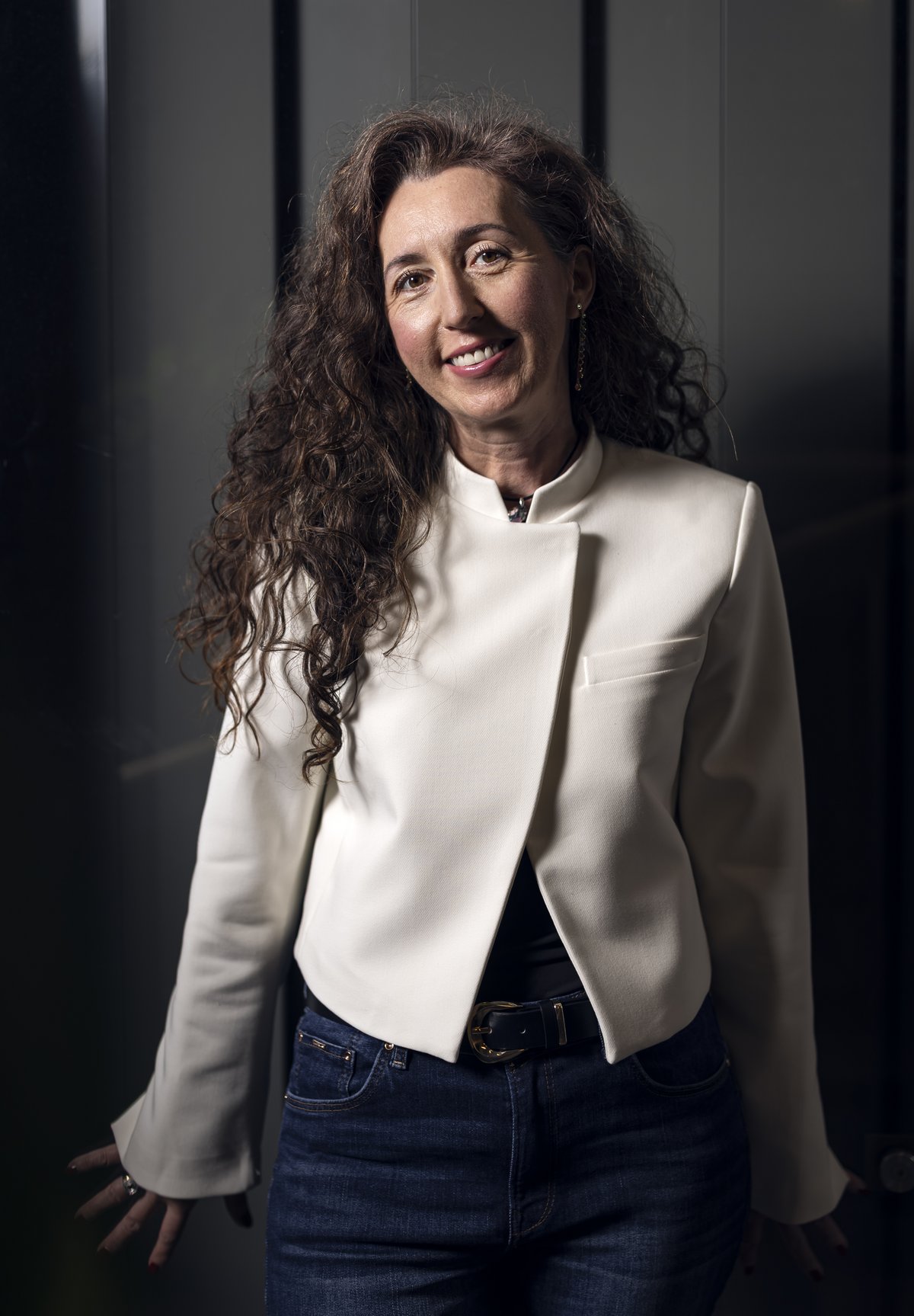
In this section, you’ll meet foreign language expert Ana Kanareva-Dimitrovska, who is a special consultant at Arts. She is also the project manager for ECML – European Center for Modern Languages in Denmark. In addition, she’s a development consultant at NCFF – The National Center for Foreign Languages, which officially closed at the end of December, but will continue for a further three months to complete reporting and finalise publications.
Globalisation and international conflicts have significantly increased the need for employees with language skills and intercultural competencies. Yet, the language subjects continue to suffer from low number of applicants. In the middle of this paradox stands Ana Kanareva-Dimitrovska, PhD, a special consultant at Arts, project manager for the European Centre for Foreign Languages in Denmark and development consultant for the National Centre for Foreign Languages.
What are your current interests?
Right now, I’m focused on tying together the threads of a year that has, in many ways, been both intense and contradictory. There has been progress in several international collaborations. Among other things, in the university alliance Circle U., where I work on a very exciting project called From Campus to Careers: Navigating the Job Market with the support of Foreign Language Skills. Foreign language skills are undervalued in the labor market, but they’re crucial for intercultural communication, for international cooperation and for handling global challenges. In the project, we’re trying to bridge that gap.
I also see progress at the European Centre for Modern Languages (ECML), which is working to strengthen foreign language teaching across 39 member countries. Many of our ideas, relationships and attempts are starting to come together.
I was also awarded the French Order ’Ordre des Arts et des Lettres’ for contributing to language policy, promoting the French language internationally, and for strengthening educational relations between Denmark and France.
At the same time, it has been a year in which I have had to deal with closures and uncertainty, especially in connection with the closure of NCFF, as funding wasn’t found in the Finance Act. Right now, I find myself caught between celebrating what has been successful and finding meaning in what has been difficult.”
What is the most remarkable thing that has happened within your field in 2025?
“It’s the clear tension between insight and reality in the field of foreign languages. On the one hand, we see a growing understanding that English as the only foreign language competency is no longer sufficient in a global and geopolitically complex world. On the other hand, applications for language programs continue to decline from an already low level. "It's a paradox. The reason is complex. It’s not only about the motivation of students or pupils, but also about the education and continuing education of teachers.
Philosopher on AI: “I’m concerned about more powerful technology we don’t understand”
At the same time, the national discourse regarding the value of foreign languages is also very crucial. We need to change the way we talk about languages. Language, and learning language, is not just about words, grammar and pronunciation. It’s a much deeper process, closely connected to emotions and identity, to people, experiences and opportunities. Learning a new language is like gaining an extra identity. You broaden your perspective, learn to think differently, see the world from new angles and connect with people you would’ve never met otherwise.”
What worries you most when you look ahead to 2026?
“It’s the clear and growing contradictions in the field of foreign languages that worry me the most. On the one hand, we see the decreasing motivation among young people to learn languages, lower recruitment to language programmes programs and very high dropout rates. In the last ten years, we’ve seen over 35 language education programmes close, and fewer secondary school students choose high-level language subjects. Right now, only five primary schools in Aarhus city and ten in Aarhus Municipality offer French. On top of that, there is a shortage of language teachers.
On the other hand, the need for linguistic and intercultural competences has never been greater. If you look at the Ministry of Industry, Business and Financial Affairs’ website, there is a lot of talk about increasing internationalisation in Denmark, that Denmark is expanding internationally, and that many Danish companies are increasingly moving into global markets. So logically, one would expect that this would lead to a growing need for language skills and intercultural competencies. You just don't see that in the job postings from companies. Denmark is not alone in facing this challenge. In many other countries, enrolment in language programmes is also declining. That worries me.”
What gives you reason for hope and optimism?
“Personally, what gives me the most hope is first and foremost the people I work with and the shared energy that arises in genuine collaborations. For example, internally at AU or in international collaborations such as Circle U. or ECML. The same applies to the dialogue between the education sector and representatives from the business and industry. It gives me a strong experience of movement, commitment and shared direction. I also find great optimism when young students meet us with curiosity and openness. I’d also like to highlight the language teachers, who show remarkable enthusiasm, even though they work in great isolation and under difficult conditions. All of this reminds me of why I chose this field in the first place, and why I find so much meaning in working across disciplines and sectors.”
This text is machine translated and post-edited by Lisa Enevoldsen.