

Students challenged sociology superstar Hartmut Rosa – and he fired back
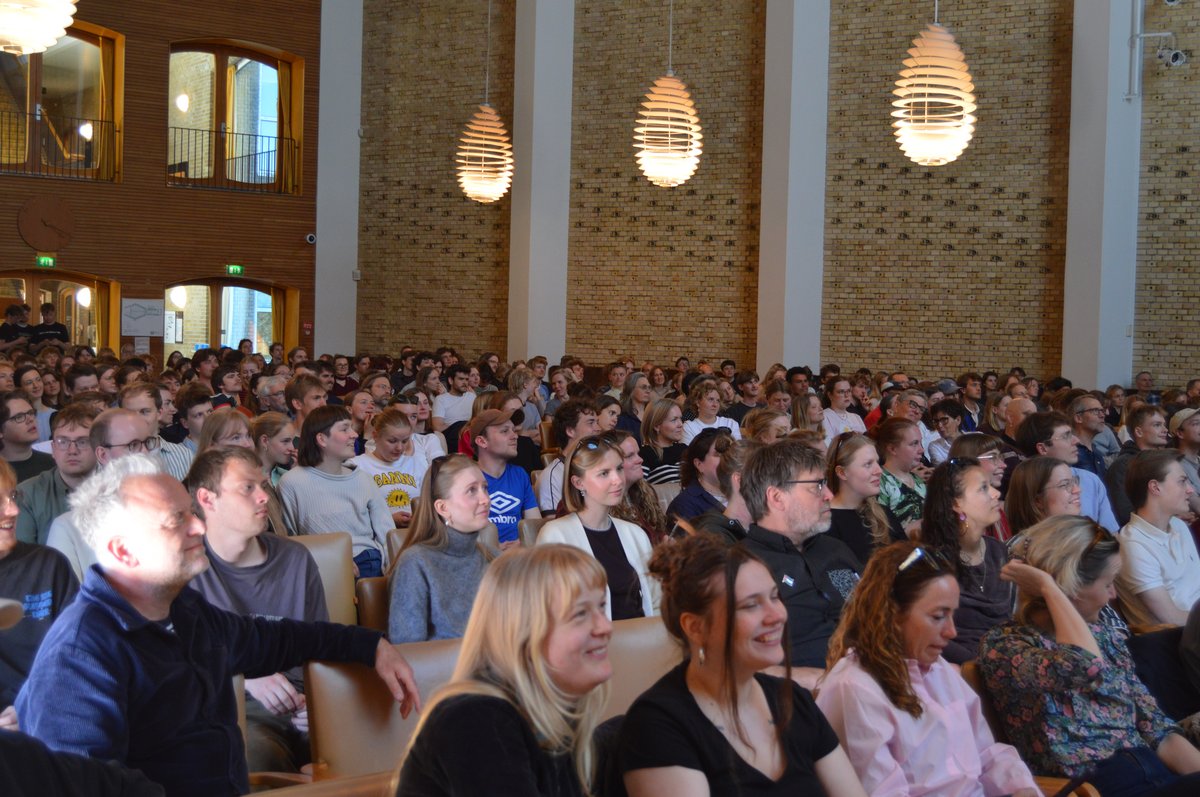
In a hall packed with future lawyers and economists, the German sociology superstar Hartmut Rosa didn't mince his words as he blamed the economists for the high-speed society in which he believes we live.

ABOUT HARTMUT ROSA
Hartmut Rosa’s 2005 doctoral dissertation, Soziale Beschleunigung (Social Acceleration), describes how constantly changing technological developments affect individuals and society. Modernity is constantly driven by economic growth, innovation, and the pressure to increase productivity. The pressure arises from competition in capitalist markets. Hartmut Rosa believes that we live in a so-called ‘high-speed society’ that is constantly accelerating.
Hartmut Rosa has since expanded his conceptual framework to include the concepts of resonance, alienation, and acceleration with his works ‘Resonance. A Sociology of Our Relationship to the World’ from 2016 and ‘Alienation and Acceleration’ from 2014.
Alienation and resonance are opposites. The internal pressures created by capitalist markets lead to alienation, and people grow hostile and indifferent towards their fellow human beings, their actions, God, the world, and nature. Resonance, on the other hand, arises when humans have a relationship with their surroundings, and where man and the outside world constantly influence and shape one another.
Source: Denmark’s National Encyclopaedia
“According to Weekendavisen (Danish newspaper, ed.), he’s one of the international superstars of our time,” said a board member of the Politological Society as he welcomed the packed auditorium to the live interview, which the association had organised alongside The Socioeconomic Society (DSS) with support from the Danish Association of Lawyers and Economists (DJØF).
And even if those present hadn’t read about Hartmut Rosa in Weekendavisen, there’s a good chance they’ve read him as part of their curriculum.
HARTMUT ROSA’S SOCIAL DIAGNOSIS
Hartmut Rosa is a professor of sociology at Friedrich Schiller University in Jena, Germany, and was awarded an honorary doctorate by Aarhus University in 2023. According to Rosa, we live in a so-called ‘high-speed society’ characterised by constant acceleration. He has also introduced the concept of resonance, which arises when humans have a relationship with their surroundings, and where man and the outside world constantly influence and shape one another.
Hartmut Rosa elaborated on his concepts during the live interview, drawing on anecdotes from his own youth. He recalls the days when you had to buy physical albums to listen to music.
“Just the feeling of holding a physical album created a kind of resonance. Now we have streaming services with millions of songs right at our fingertips,” he said.
“It is alienating for humans to constantly have so many options”
“It is alienating for humans to constantly have so many options,” he said.
Hartmut Rosa also praised the organisers’ decision to open the event by singing Halfdan Rasmussen’s ‘Noget om helte’ (Something About Heroes), which, fittingly, deals with making the most of the here and now, and what is right in front of you. Was Halfdan Rasmussen ahead of Hartmut Rosa’s concept of resonance?
QUESTIONS IN, LECTURE OUT
Every time the two moderators asked Hartmut Rosa a question, he responded with long answers and paced back and forth on stage. Obviously used to lecturing and teaching students.
Staging the event as a live interview rather than a presentation or a lecture provided the opportunity to challenge Rosa on some of his points, explained one of the two moderators, August Østergaard Nilsson, after the event.
“Many people are familiar with Hartmut Rosa’s theories and key points. Most people have a clear overview at least,” he said.
“We had a few points of attack where we wanted to challenge him on the empirical foundation. For instance, we didn’t understand why the analysis makes sense when working hours in Western Europe have actually fallen in recent years,” said August Østergaard Nilsson.
So, what was Professor Rosa’s reply?
“The time we spend at work and our free time is simply more condensed,” he said.
“After all, we’re still working because capitalism has promised us that it will give us a better future,” said Hartmut Rosa.
“IT’S THE ECONOMISTS!”
But Rosa also fired back. As mentioned, humans are under pressure because of the competition in capitalist markets. And the economics and political science students in attendance were made well aware of this.
When Hartmut Rosa was asked about the reasons behind people’s alienation from their surroundings, he simply replied: “It’s the economists!”. That, however, didn’t seem to offend any of those gathered. Instead, the blunt reply was met with laughter from the audience. Hartmut Rosa explained how, as a society, we have created a shared identity that depends on innovation, growth, and acceleration in order to maintain its own structure.
And these dynamics create a need to constantly step up the pace.
“We like to live life at a fast pace because it gives us a sense of freedom. Modernity sets the world into motion,” said Hartmut Rosa.
“It becomes a problem when the high speed leads to alienation,” he said.
Hartmut Rosa, however, hadn’t come to tell off the future lawyers and economists or ask them to slow down. According to him, these theories are suggestions on how we, as individuals and as a society, can understand ourselves.
And perhaps an explanation for the growing lack of well-being among young people. "The fast pace that leads to alienation also leads to a great deal of aggression towards ourselves and the world around us," said Hartmut Rosa.
“The answer isn’t simply to slow down, but to adopt a completely different approach to the world around us. Take nature, for example. We should not seek to control or possess nature; instead, we must learn to live in harmony with it,” said Hartmut Rosa.
DSS was brave to invite a critic into their own home, but it was also a deliberate move, explained the other moderator, Henrik Spliid from DSS.
“Our aim as an association is to engage economics students in debates that go beyond the curriculum,” said Henrik Spliid.
“Hartmut Rosa approaches economics in a radical way. One criticism levelled at economists is that we don’t always consider why we do what we do and think the way we do,” he said.
NOT JUST DJØF MEMBERS IN THE AUDIENCE
Especially the aspect of our well-being and the lack thereof caught the attention of the two psychology students, Signe Krakauer and Emma Degn, who are both in their fourth semester.
“He places a great deal of emphasis on well-being, which is very relevant to us. I think there are quite a few of us psych students here today,” said Signe Krakauer.
“I read about him in Zetland and thought the concept of resonance sounded quite interesting. And it was free,” said Emma Degn.
Rosa’s ideas also struck a chord with journalism student Kristian Fischer.
“He’s just fascinating. These are some great thoughts and ideas, and you can see your own everyday life reflected in them," he said.
This text is machine translated and post-edited by Mie Skov Jeppesen.