

AU researchers came up with the idea for a new exhibition about the overlooked body
A new exhibition at the Steno Museum blends crochet, statistics, and organs as it explores why the biologically female body has been overlooked in research - and visitors can experience the world’s largest crocheted placenta or lounge in breast-shaped furniture.

The exhibition “The overlooked body – blood, breasts, and inequality” shines a spotlight on the female body, which has traditionally received less attention in research. The exhibition sheds light on the consequences of the fact that the male body has predominantly been used in research on both healthy and diseased bodies, including research into diseases that affect women.
At the exhibition, visitors can lounge in a breast-shaped piece of furniture that visualises a dissected breast, or examine a real uterus donated by a woman with endometriosis.
Researchers came up with the idea for an exhibition
The idea for the exhibition was jointly developed by Felicity Mae Davis, associate professor of biomedicine, Christine Parsons, professor at the Department of Clinical Medicine, and a core group of researchers at AU with an interest in women's health. The research group has received funding from the Novo Nordisk Foundation for their exhibition project.
Felicity Mae Davis conducts research on the female body herself – specifically on breast development during pregnancy. Over the years, this research has led her to reflect on the overlooked body.
“We have started to learn more about female biology and women’s health, but it is still a major problem,” she says.
The female body was often excluded from research up until the 1990s. This was mainly due to the fact that women menstruate and that their bodies are therefore affected by hormones. This makes trials more expensive and more difficult to conduct. At the same time, researchers feared harming a foetus if the participants became pregnant during the study.
However, the decision not to use women's bodies in research has far-reaching consequences. For example, many women with endometriosis live for years without being correctly diagnosed. Therefore, the exhibition also offers insight into life with endometriosis, and it contains several accounts from women suffering from the disease. In addition, a woman with endometriosis has donated her uterus to the exhibition.
Longer lives, poorer health
"Exhibitions like the one at the Steno Museum help draw attention to this gap in knowledge, but it is not a problem that can be solved quickly or in isolation," says Felicity Mae Davis.
"When you research different areas of the female body, you quickly discover just how big the problem actually is," she says.
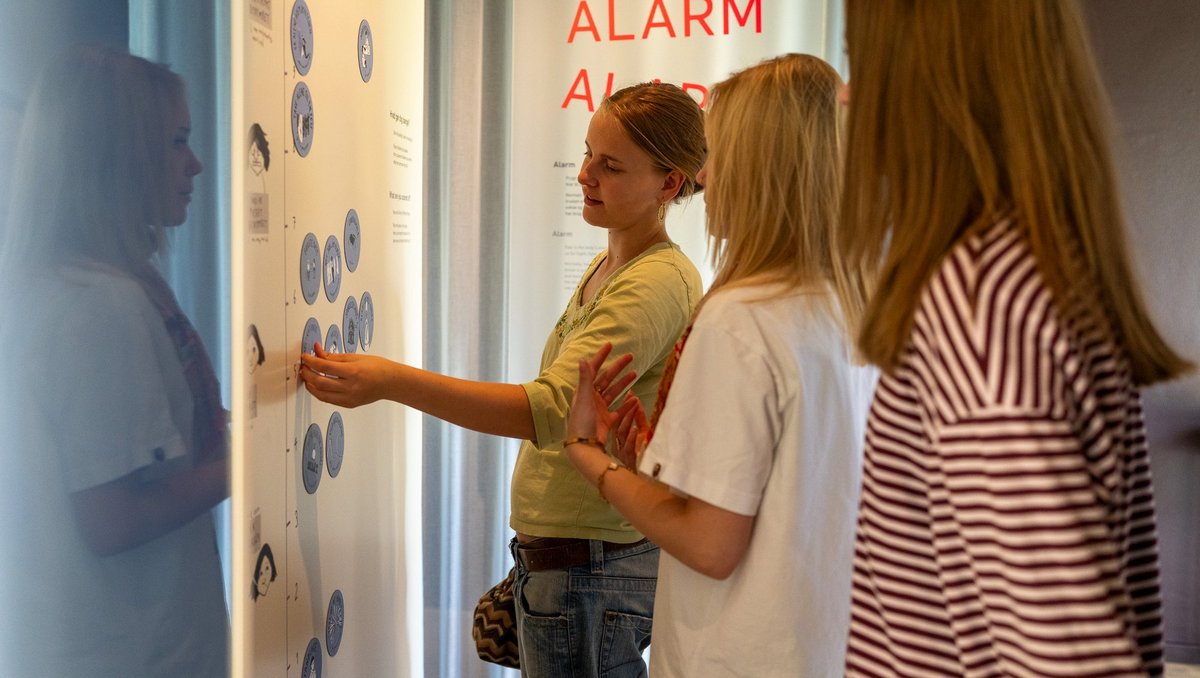
Although men worldwide have a shorter life expectancy than women, women typically live longer with poorer mental and physical health. Students from Aarhus Continuation School have developed a work about anxiety in collaboration with the two artists, Amanda Kessaris and Ida Fonslet. The diagnosis affects twice as many women as men, and we do not know exactly why.
Christine Parsons conducts research into women's mental health, including during the perinatal period, which is the time during pregnancy and after childbirth.
"Some mental disorders are more prevalent in women, and it is difficult to say exactly what causes this," says Christine Parsons.
Anxiety disorders have long received greater attention, and as a society, we are talking about them more and more, says Christine Parsons.
"My contribution to the exhibition has been to explain the scientific study behind anxiety," she says.
"It’s not that we know nothing, but there are many factors that affect women’s mental health," she says.
Christine Parsons points out that factors such as sleep deprivation associated with caring for a newborn, hormonal changes, and socialisation may help explain why women are more frequently affected by anxiety than men.
Exhibition created with the users
Ella Paldam, deputy director and head of learning at the Science Museums, tells Omnibus that the application for the exhibition was prepared in 2022, so the exhibition has been a long time in the making.
“We have opened the exhibition in two phases. In the first phase, a large curtain divided the room in two: one part was a smaller exhibition, and the other was a workshop space,” says Ella Paldam.
The first phase of the exhibition opened in January 2024 at the Steno Museum located in the University Park.
Ella Paldam also notes that the Science Museums' primary target audience is children and young people. The first phase of the exhibition thus allowed the museums to create a collaborative development process involving researchers, artists, and a large number of young people. A total of 400 students from lower secondary and upper secondary education participated.
"The concept worked really well because it allowed us to collaborate with many different groups and view the problems and opportunities through various perspectives," says Felicity Mae Davis.
At the exhibition’s exit, sheets of paper are displayed, featuring handwritten thoughts about the exhibition from students at Aarhus Continuation School. Here, they note what is most important to know about the exhibition. One of the notes reads: "How many lives can be saved if we also conduct research on the female body? It is not just a question of gender equality, but of life. The note is supplemented by a drawing of a female body.
Organs, anatomy, and crochet
The exhibition was created by a community of researchers, artists, and students from Aarhus Continuation School. Ella Paldam explains that the art sparks the visitors' curiosity about the organs of the female body.
“The exhibition also features the world's largest knitted placenta. Right next to it are real placentas in glass containers. It is as if the large artwork quite naturally draws the visitors' gaze and conversations toward the real organs, which many people might otherwise find a bit off-putting," she says.
"It was part of the application to the foundation that the exhibition would use art to spark a sense of wonder and curiosity, and this also aligns very well with the way the Science Museums operate. We want to give young people a sensory way of engaging with scientific issues," says Ella Paldam.
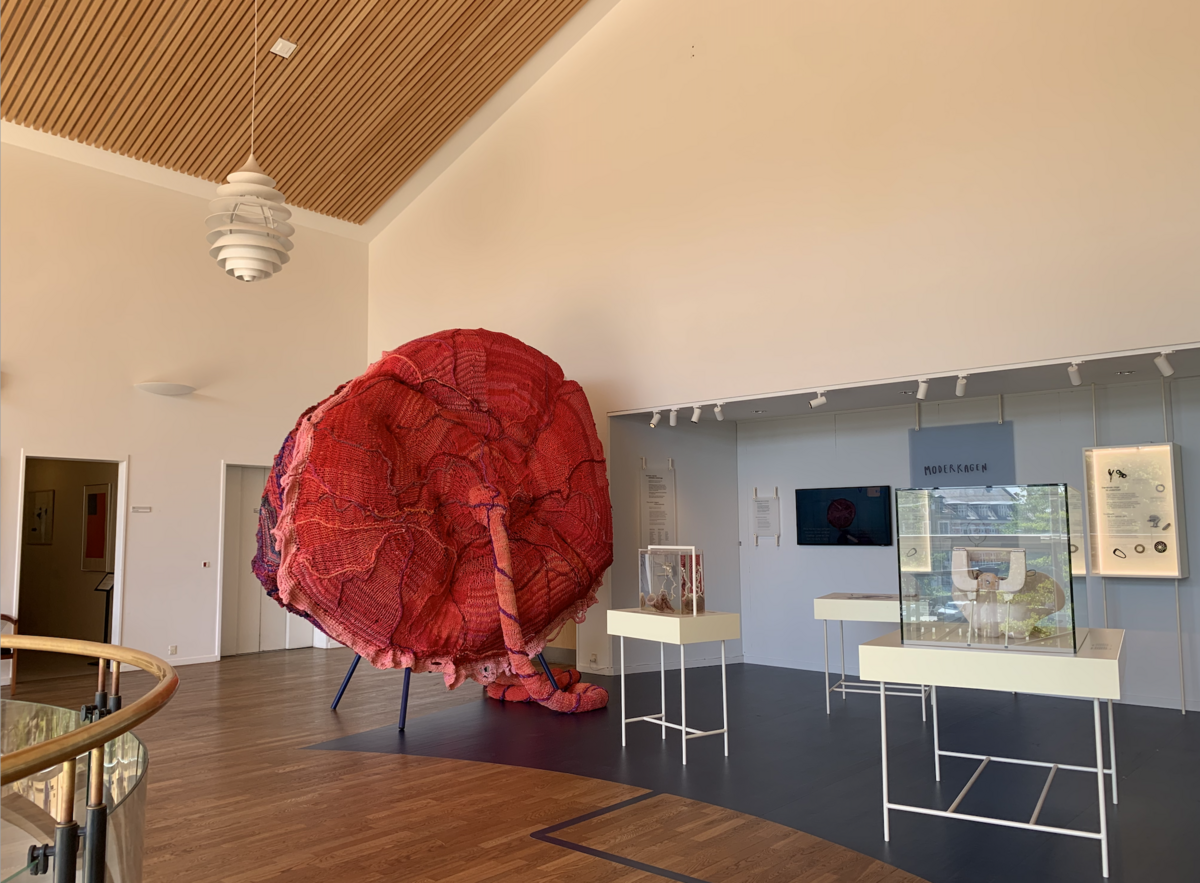
The large breast-shaped furniture, which visualizes a dissected breast, was developed by set designer Caroline Bang Hedegaard and AU researcher Felicity Mae Davis, who helped visualize the anatomy of the breast.
"We hope that the art can draw attention to what lies beneath the skin of the breasts," says Ella Paldam.
"It has been interesting to see how the artist and the researcher have collaborated to get the anatomy just right in the work," she says.
In addition, you can also refresh your CPR technique using a female manikin. Small lights on the mannequin's shoulder tell you whether you are doing it correctly.
The exhibition is on display at the Steno Museum in the University Park, and admission is free for students.
This text is machine translated and post-edited by Mie Skov Jeppesen.