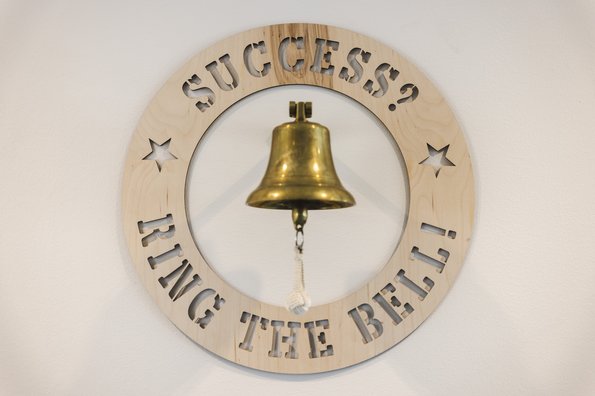

At Business Factory students try to cash in on what they have learned
For 20 years, Business Factory at AU Herning (Department of Business Development and Technology) has helped students create a business out of a good idea. Several well-established companies started at the factory and have since grown into what people in Jutland, with some understatement, would call 'fine businesses'.

Business Factory was established in 2005 as part of the then Institute of Business and Technology Herning, which merged with Aarhus University the following year in 2006. With a DKK 5 million grant from the Danish Enterprise and Construction Authority, Business Factory established itself as the first student incubator or entrepreneurial hub in Denmark. On Wednesday, Business Factory celebrated its anniversary with the inauguration of brand new premises and the new MakerStreet, which is an extension of the workshop facilities that students have access to in AU Herning.
Jan Kvist Martinsen is an Associate Professor at the Department of Business Development and Technology and has been the head of Business Factory for 19 years. He shows around the new premises and says that students are welcome from day one at the studio.
“We create a community and synergy between those who have already tried their skills in entrepreneurship and cashed in on it, and those who have not yet. We do that in a very informal environment where the door is open, and you just walk in and be a part of it,” he says.
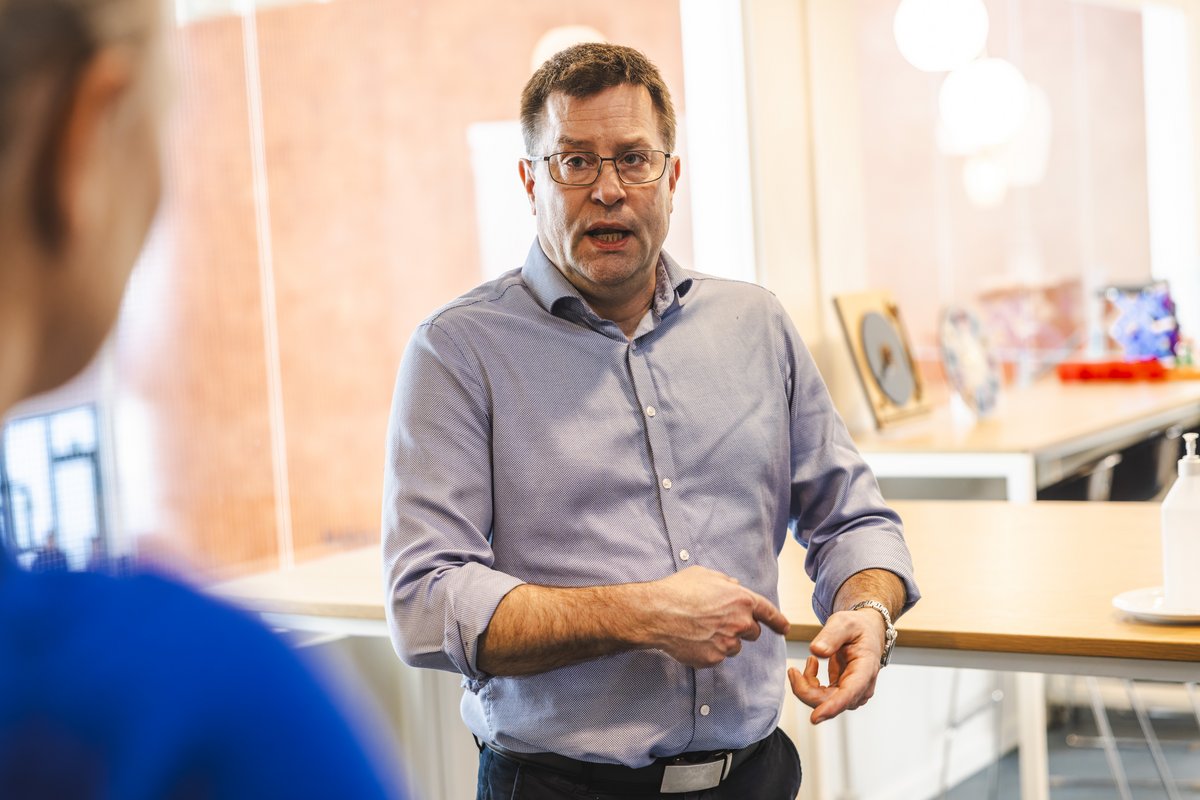
Jan Kvist Martinsen teaches both the students who are studying business development (BDE) and guides those who want to try their skills in entrepreneurship alongside their studies.
At one end of the room, there is a lounge area, meeting rooms and open office spaces. At the other end, behind a glass wall, sit the more established companies – those with CVR numbers.
LEARN FROM EACH OTHER
Behind the glass wall sits Rasmus Hvass Pedersen, who graduates as a mechanical engineer in January 2027 and runs EdgeWay ApS alongside his studies. The company provides consulting services to, among others, the mechanical engineering industry.

He got to know Business Factory as early as three months into the study programme because he wanted to develop an app at the time. He can relate to the fact that you learn a lot from the other students who are also starting a business — and from the guidance he has received over the years from Jan Kvist Martinsen.
Opposite him sits Jano Boelt, who has entered Business Factory somewhat by accident and is part of the company Bolt Vision, which makes automated quality control for iron companies.
“I didn't really dream of becoming an entrepreneur, but I became part of a project that has turned into a company because I had the skills needed,” says Jano Boelt, who also studies Business Development (BDE). Now he sees it as an opportunity to gain experience.
He has both drawn on the facilities in Business Factory and on guidance from Jan Kvist Martinsen and other supervisors.
“They have helped with reading through documents and with guidance on fund applications. And I've been able to draw on their networks as well.”

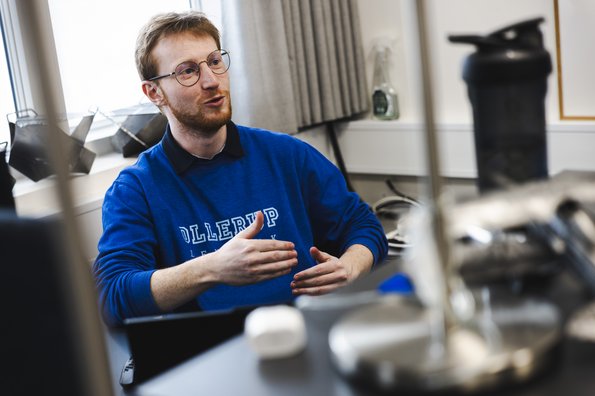
FROM STUDENT GRANTS TO MILLIONS
Over the 20 years, 120 companies have been launched out of Business Factory. One of them is V2 Tobacco, a snuff factory started by brothers Patrick and Marc Vogel in 2006. They developed a snuff-like product of chopped tobacco and chewing tobacco, which can be sold in countries where snuff is banned. According to Finans, they sold the company to Swedish Match in 2017, and each made DKK 300 million from the sale.
“Nobody believed them when they started — not banks or teaching staff. It was an old industry without a domestic market, so it looked hopeless,” Jan Kvist Martinsen says.
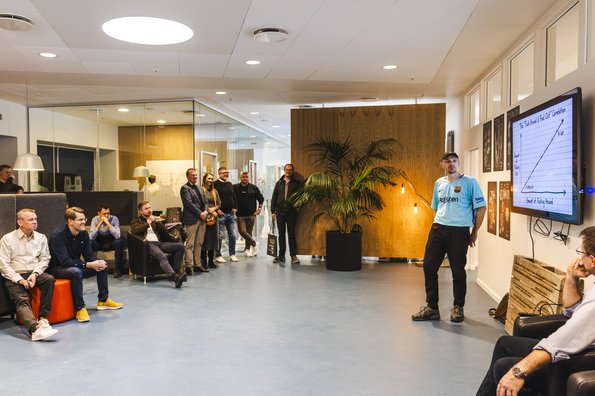
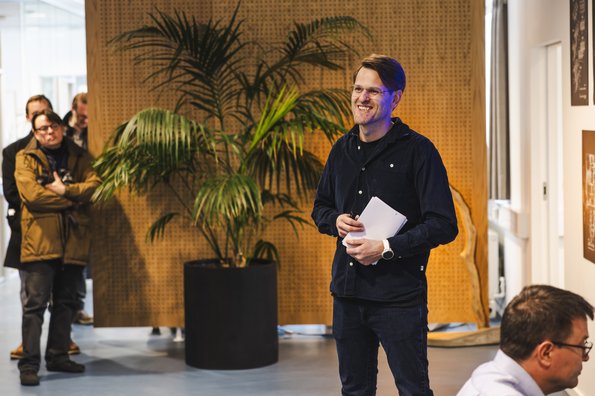
Several of the former students who have gained their first experiences of entrepreneurship in Business Factory also attended the anniversary. Among them is Anders Nordemann Nees, who runs the company Illux, which he started in his fifth semester of the Business Development programme together with three of his friends.
“Illux will be 20 years old in April, we have 48 employees, sell to three countries, generate sales of DKK 60 million per year and grow 10-20 percent per year,” he said in a brief presentation in Business Factory.
“In Business Factory, we learned that bad ideas cost money, and good ideas make money. You quickly find out what's the most fun.”
Andreas Nielsen has had a similar experience. He is co-owner of the company Confect, which has developed a software that retailers can use to generate online ads, and IKEA, Audi and JYSK are among its customers. He operates according to the so-called ‘fuck around and find out’ correlation:
“The more you fuck around, the more you find out.”
The road leading to Confect was by no means straight. Among other things, he developed the 'I have never' app and has also tried his hand at selling cheap hygiene products on the web, before finding out that part of the secret to successful entrepreneurship is solving an actual problem someone has.
“But if we hadn't been such big fuckheads, we'd never have tried the things that we've tried and found out what we can do,” he says.
MAKERSTREET

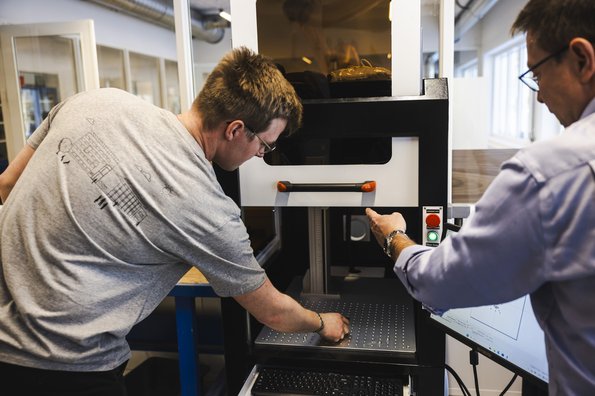
As part of the 20-year mark, the students at AU Herning, and perhaps future entrepreneurs, have expanded the workshop facilities that they use, among other things, to create prototypes. They call it MakerStreet – the hallway where students have access to 3D printers, laser cutters for wood and metal, new milling machines and lathes, laser welders, and even a chocolate printer.
Jan Kvist Martinsen explains that the aim is to give students experience of using machines in a quality that they will also encounter in industry, and to enable them to make prototypes of products.
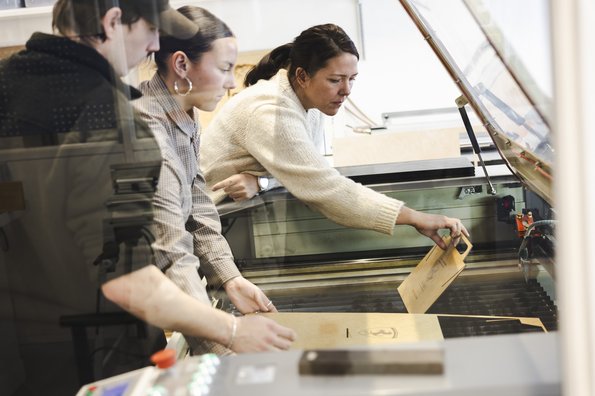
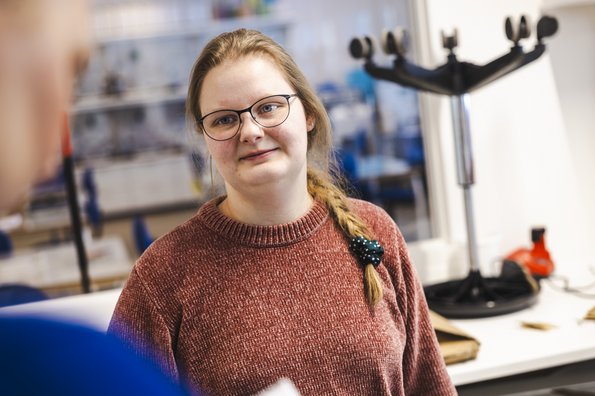
This is exactly what a group of students in the second semester of business development is doing as part of a workshop course. They are very pleased with the new facilities:
“If we get an idea, we have the facilities to make a prototype of the idea and see if the idea holds up,” explains Helle Ørup Birkjær, while her fellow students are making a prototype of a wooden folding grill to see if the assemblies are correct before producing it in metal, which is a more expensive material.
Jan Møller Nielsen, who is a technical supporter of MakerStreet — or the chief of the workshop, as Jan Kvist Martinsen calls him — notes that the students are good at working with the digital and computer-based workshop machines. They struggle a bit more when it comes to swinging a hammer.
“But they haven't had a woodwork course since sixth grade either,” he says.
For him to see, mopping around with tools and machines has great value as a budding entrepreneur.
“It helps to have things in your hands. You have to take things apart to get an understanding of how they work. I think it's hard to get the really good ideas without having that insight,” he says.
This text is machine translated and post-edited by Lisa Enevoldsen.