

COLUMN: The University City offers a unique opportunity to create new connections
The opening of the University City was the culmination of a project that has lasted more than a decade. It was a manifestation of Aarhus University's ambitions – and not least, it was an opportunity to feel proud of the role our university plays in society," writes Rector Brian Bech Nielsen in his column.

THE SENIOR MANAGEMENT TEAM COLUMN IN OMNIBUS
The nine members of the senior management team take turns writing the senior management team’s Omnibus column. The columnist chooses the topic, and all the opinions expressed in the piece are the columnist’s own.
The senior management team contributes content on the same terms as all other Omnibus authors of columns, articles, or opinion pieces.
The views expressed in this column are the author’s own.
Would you like to join the debate?
- Send your content to omnibus@au.dk
This is an opinion piece; the views expressed in the column are the writer’s own.
Daily life at the university is filled with academic and political themes that deserve to be debated – and fortunately, this happens every single day.
But as I expressed at the opening of the University City, there are also occasions when you have to allow yourself a prolonged moment in the joyful and the high-spirited – and perhaps even the slightly sentimental.
This column will be such a moment. Because the opening of the University City is worth dwelling on. It was the culmination of a project that has lasted more than a decade and has required a Herculean effort from an enormous number of people.
The work is not over yet – it will still be a few years before the last excavators move out and the last employees and students move into the University City. But the visit from His Majesty King Frederik 10th and the following public celebration was a major milestone. It was a manifestation of Aarhus University's ambitions – and not least, it was yet another opportunity to feel proud of the role our university plays in society.
Not just buildings
For many people, the workplace is most of all a place where they show up to work.
Personally, I don't feel that way about Aarhus University. For me, the University Park in Aarhus is filled with memories, meaning, and symbolism, and I highly appreciate that our shared history is woven into the surroundings. Many of our staff, students, and alumni have similar feelings about the place – and I hope that this will also apply to the University City.
From the beginning, it was a goal that the new space should be carried out with respect for the original buildings. Partly because they constitute an important architectural cultural heritage, but also out of respect for the many fates that, for better or worse, have been affected by the old Municipal Hospital.
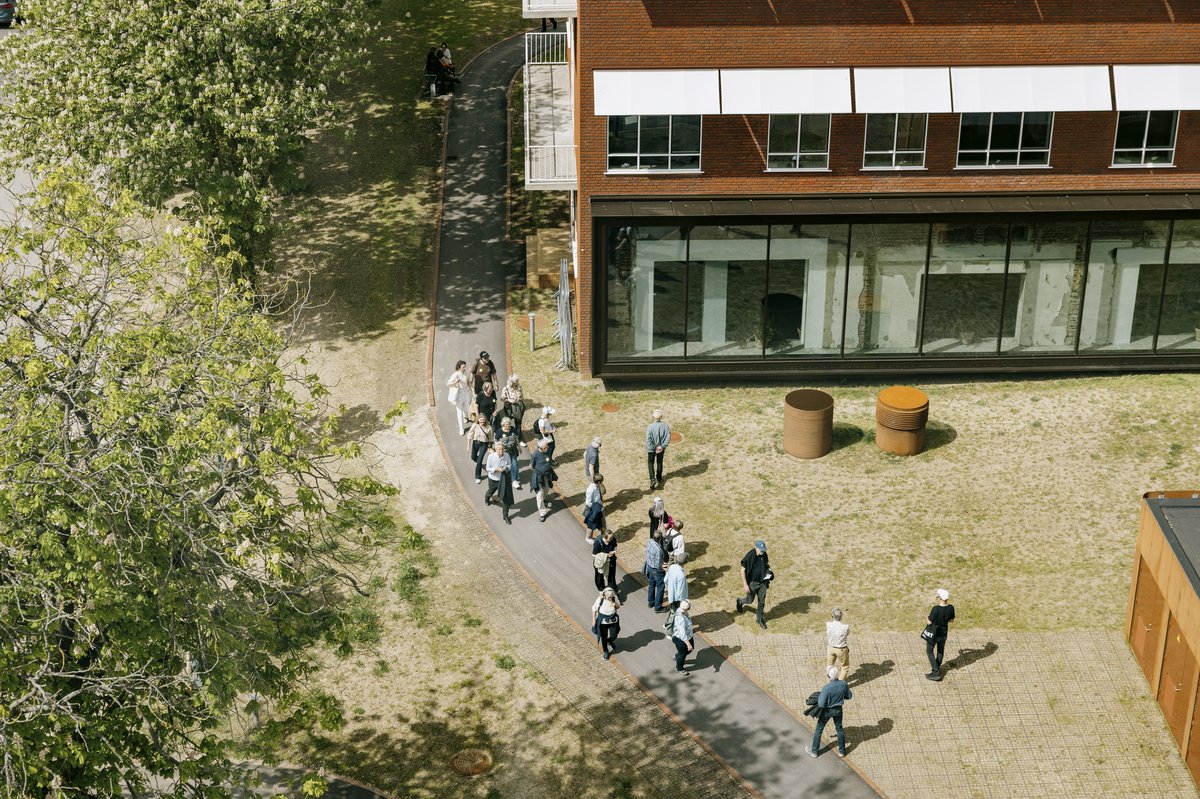
That project has been fully successful – the University City exudes history and stories. Take, for example, building 1814, which was part of the hospital's X-ray and light clinic, where large scanners were built into the wall. Instead of building a new façade, a glass section has been placed on the outside, so that you can still see the holes left by the scanners – a reminder that the building once had a different function.
Another example is the new building 1791 located at the University Square opposite the City Auditorium. Here, an architecture student won the task of decorating the café – with the caveat that the artwork would use the Municipal Hospital's old ceiling panels. The same ceiling panels have been used as acoustic panels in several of Aarhus BSS' buildings – literally an echo of the past.
Rare opportunity
The history is thus noticeable everywhere in the University City – and now we can look forward to future generations of students and staff creating new stories. Because the University City is not only about the past and aesthetics – but also about functionality and the future. And here the perspectives are just as great.
The University City offers a unique opportunity to create new connections between our academic environments. It is rare for a university located so close to the city to have the opportunity to design such a large campus area in close proximity to the existing one. And there has been an exemplary collaboration between the Aarhus University Research Foundation, FEAS, architectural firms, and not least staff and students to design the buildings so that they offer modern, functional, and flexible conditions for both research and education.
At the same time, the University City illustrates that innovation has become an integral societal task for us. Kitchen has a visible location, and the same applies to Partnerhuset, where companies can establish themselves and be close to the university's many creative and knowledgeable forces. The future centre for innovation and entrepreneurship will also be housed in the University City.
Finally, the opening of the University City was a celebration of the fact that Aarhus University is open to everyone. It was a pleasure to see so many guests at the opening party, and it reinforces our hope that we have succeeded in creating an urban space that is attractive to the university's staff and students as well as the wider public.
This text is machine translated and post-edited by Mie Skov Jeppesen.