

Future students are already battling "the AI beast"
Dean Maja Horst sat in the front row when the Union of Danish Upper Secondary School Students held its first AI summit at Aarhus University. She believes that AI requires us to rethink both teaching and exams, and therefore welcomes the pupils’ initiative, as many of them will be studying at university within a few years.

The last remnants of Friday's annual celebration in the Aula had barely been cleared away before coffee and croissants were laid out on Monday for a summit on the untamed beast at the heart of education's latest revelation: AI.
The summit was convened by the Union of Danish Upper Secondary School Students who, in the words of Chair Oscar Tønsberg Hoffmann, are “already battling the unregulated beast.”
“A lot is missing when it comes to AI in upper secondary education. There is no national framework for how AI should be used, and as a result practices vary considerably from one school to another, with conditions differing widely,” says Oscar Tønsberg Hoffmann.
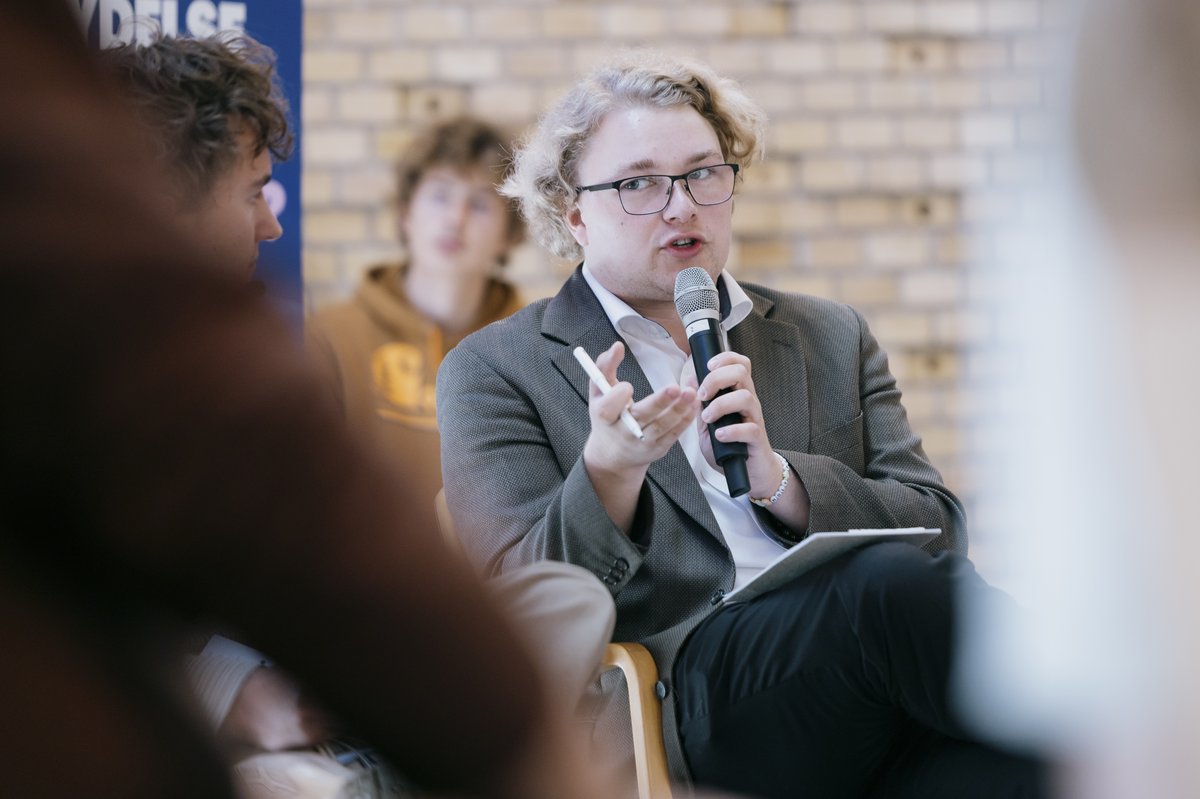
Although the summit focused on upper secondary schools and the students’ nine recommendations for the future use of AI in education, Maja Horst, Dean of the Faculty of Arts, sat in the front row and gave the opening address alongside Oscar Tønsberg Hoffmann.
Nine AI recommendations
The Union of Danish Upper Secondary School Students has drawn up nine recommendations for the future use of AI in upper secondary education:
1. Teaching should maintain the students' academic competencies
2. Interdisciplinary course on digital literacy and artificial intelligence: The course should be structured around a series of cycles, comprising three modules spread across students’ time in upper secondary education. It should combine practical and theoretical elements and draw on multiple subjects, enabling students to learn how to use and critically engage with AI, technology and other digital tools.
3. Course content: Digital knowledge and skills are essential for navigating society. The “Digital Literacy” course should be designed to help students acquire these competencies.
4. Strengthening the pedagogical competencies of teachers, school leaders and guidance counsellors
5. Consistent guidelines for the use of AI
6. Responsible digital frameworks: In the longer term, it should also be explored whether it would be possible to develop a partly Danish AI model in collaboration with relevant partner countries, thereby ensuring digital sovereignty.
7. Fair and due process for written assignments: There must be a nationally agreed approach to investigating, documenting and handling AI-related cheating, so that procedures are fair and consistent across the country.
8. New exam formats
9. Sector involvement
Source: The Union of Danish Upper Secondary School Students (In Danish, ed.)
“It’s really great that you, the upper secondary school students, have taken the initiative to organise today’s event. That you don't just wait around for teachers, politicians or universities to figure out what to do with artificial intelligence, but that you enter the discussion and take responsibility yourselves," Maja Horst said to the upper secondary school students in the Main Hall.
A shared task
Minister of Science, Higher Education and Digital Affairs, Christina Egelund (M) attended the summit and spoke about the experience of integrating computers and the internet into the education system. She drew parallels with the challenge that artificial intelligence has now set for students.
“You are the first to have to figure out how to work and create in a world where artificial intelligence is part of everyday life. And you must not only learn how to use it; you must also learn how to learn alongside artificial intelligence,” the minister said, outlining the division of responsibilities she believes will be needed to integrate AI into education.
“Teachers must ensure that the technology works in the classroom. Rectors must ensure that this is done in a proper way, and researchers must help us understand the technology’s strengths and how it can be used. Of course, we politicians also have a task. We must ensure that the frameworks we create allow for both innovation and responsibility. There probably isn't one model for the entire education system, and we're going to have to look at this again and again," said Christina Egelund.
Same challenges
Many of the questions the upper secondary school students have begun to tackle with their nine recommendations can be transferred directly to the universities. Not necessarily in the same form, but the underlying challenges are the same.
“It’s about the framework governing its use. It’s about how we conduct examinations, exam cheating, how it changes our perception of different subjects. It’s about due process and learning, and so on.” We are expected to use AI constructively, critically and responsibly, but that requires us to be properly equipped to do so,” says Oscar Tønsberg Hoffmann, before continuing:
“We are already battling an unregulated beast. AI is here to stay. It is part of everyday life and our education. That’s just how it is. We want to lead the way and invite decision-makers to work with us to create a strong framework for the future use of AI.”
More specifically, the upper secondary school students propose that future teaching should cover AI, make use of AI, and teach students about AI. They envision this taking place in a three-year cycle spanning the first, second and third years of upper secondary education, allowing the curriculum to be continuously updated and adapted in line with technological developments.
The students also envisage AI being incorporated into subject curricula in ways that reflect the needs of each discipline, recognising that AI can neither be used, nor should be used, in the same way in history as it is in mathematics.
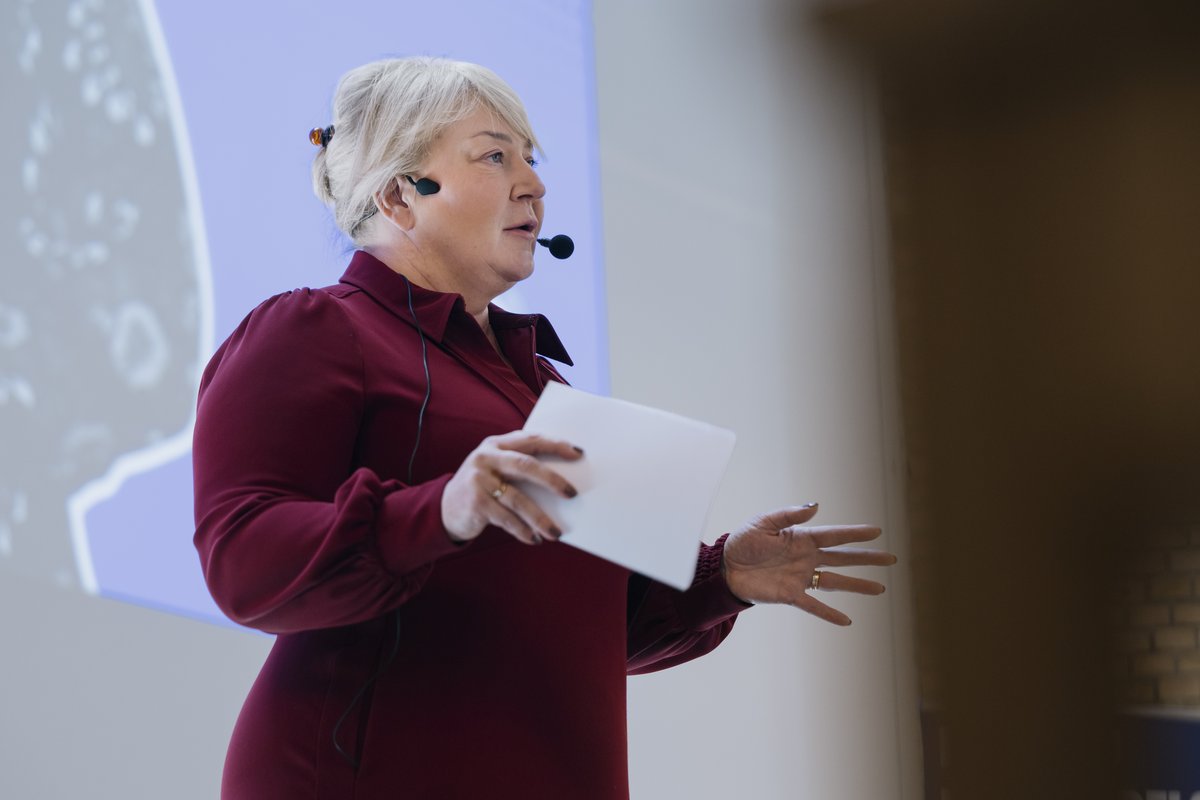
AI requires us to rethink
Before long, today’s upper secondary school students will be arriving at university as the next generation of students. For Dean Maja Horst, the summit was therefore an interesting opportunity to see AI in education from the perspective of upper secondary school students.
“They are addressing many of the same challenges that we are dealing with at universities. I understand why they’re calling for decisions and frameworks. We’re all still learning, and no one likes having things imposed on them. That's why it's important that we do this together," says Maja Horst.
She believes that the entire education sector is facing a transformation as a consequence of AI.
“We need to teach in completely different ways if we are to make the most of everything AI has to offer, and that requires us to invest time and effort in rethinking how we do things. The current practice of following up a written assignment with an oral examination is a temporary solution. We need to rethink examination formats so that they reflect the new reality shaped by AI,” says Maja Horst.
This text is machine translated and post-edited by Mie Skov Jeppesen.