

Art – Now with who, what, and when
Around 100 of the most prominent artworks displayed across the university will now be fitted with information plaques, making it possible to learn a little more about who created each piece, what it is called, and when it was made.

Across Aarhus University, more than 1,000 artworks help shape the environment in which students and staff study and work. The artworks, which primarily consist of modern art by Danish and international artists, have been part of the university's history since 1932, when the first buildings were erected on campus in Aarhus.
At the Department of Mathematics, colourful works by Erik Winckler and other artists adorn the yellow brick walls.
"We often talk about the artworks, and it's really cool that there is something to look at and talk about," says Maya Thingholm, a 9th-semester Mathematics and Computer Science student.
“Every now and then, my eyes will linger on a work hanging on the wall of an auditorium when my mind starts to wander,” she continues.
Together with fellow Mathematics and Computer Science students Laura Sticker Gregersen and Stine Juhl Pedersen, Maya Thingholm is making her way down the stairs at the Department of Mathematics when she runs straight into an Omnibus reporter and Lotte Philipsen, who, in addition to being an associate professor in Art History at the School of Communication and Culture, is also chair of Aarhus University’s Art Committee.
The three women happily stop to take a look at the three large artworks hanging on the yellow brick wall at the foot of the staircase.
Lotte Philipsen explains that the works have now been fitted with small plaques, making it possible to find information about each individual piece.
"Yes, and it actually becomes more meaningful when a name is added to it," says Maya Thingholm.
And that is exactly the idea behind the new plaques that the Art Committee is currently installing across the university. Around 100 of the university’s most prominently displayed artworks are now being fitted with small plaques providing information about who created the work, what it is called, and when it was made.
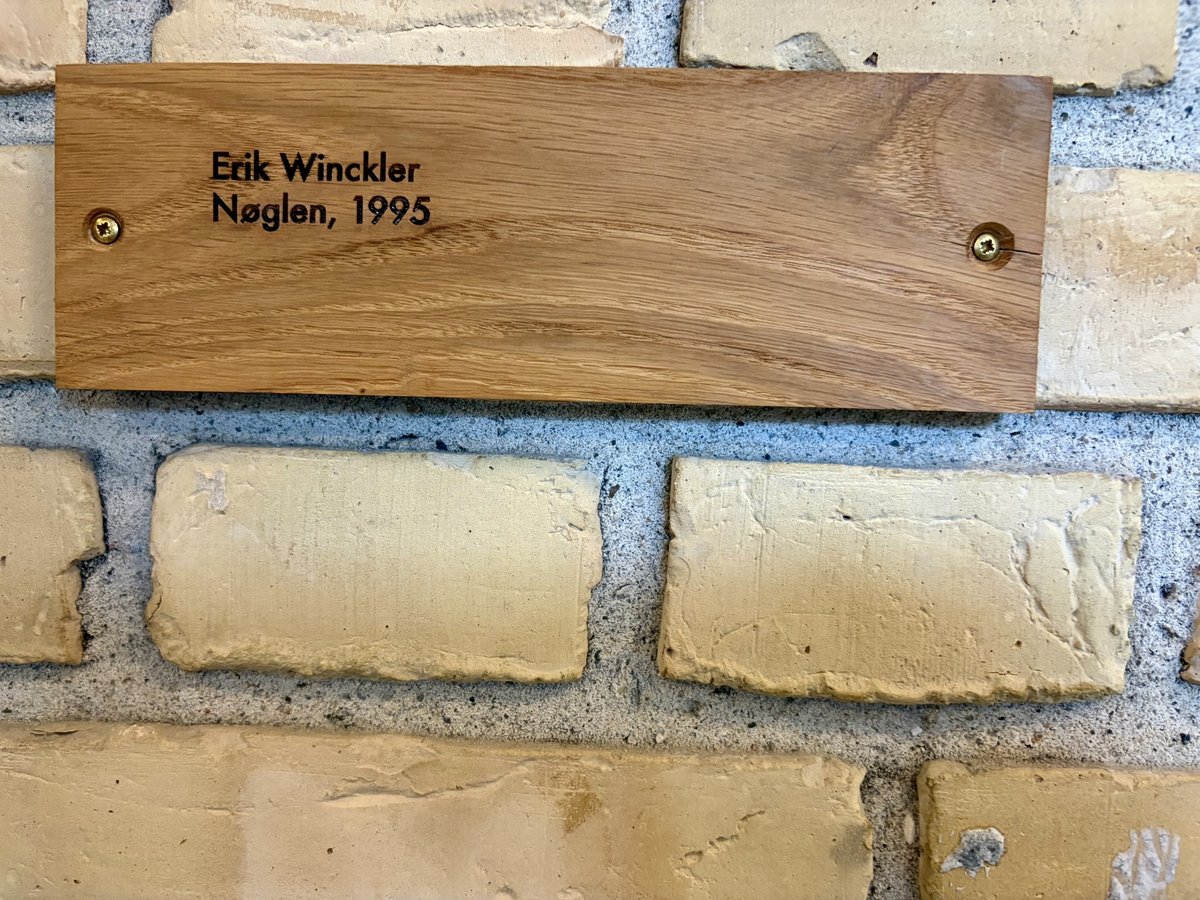
And until recently, there was no way of knowing that one of the works hanging at the end of a staircase in the Department of Mathematics was Erik Winckler’s The Key from 1995.
"The art at Aarhus University comes from many different places, and there are many different people who have helped select them over time. Art is not one of the university’s core responsibilities, and as a result, communicating and contextualising its art collection has not been a high priority,” says Lotte Philipsen.
A tribute to the man behind the idea
The Art Committee already knew that the artworks needed plaques, but what finally prompted it to prioritise the project was a job application submitted a few years ago by a Mathematics student hoping to land a student job with the committee.
"He didn't get the job, but his application was really nice and made an impression. He told us that he really enjoyed the art around the university, but felt that the works lacked plaques that could provide a bit of information about them,” says Lotte Philipsen.
Since then, the Art Committee has revisited the idea several times, and it is now being turned into reality. As a result, around 100 small plaques have now been produced and will initially be mounted next to various artworks across the university.
"We’ve talked a lot about how to make plaques that look nice, are more climate-friendly than brass, and that fit with the many different buildings at the university. And then we came up with the idea to use some of the oak that had been preserved from the time when a number of oak trees in the University Park had to be felled to make way for the underpass connecting the park and the University City,” says Lotte Philipsen.
Felled oak tells the story of solar storms, nuclear tests, unleaded petrol - and AU’s history
Several of the artworks at the university already have signs, and these will not be changed out. However, 100 of the university’s most prominently displayed artworks, which have not previously been accompanied by plaques, will now be flanked by oak plaques.
“And of course, the first plaques were installed next to the works hanging in the Department of Mathematics, in honour of the Mathematics student who first planted the idea,” says Lotte Philipsen.
This text is machine translated and post-edited by Mie Skov Jeppesen.