

Felled oak tells the story of solar storms, nuclear tests, unleaded petrol - and AU’s history
A new exhibition in the Stakladen bookshop’s foyer combines natural and cultural history in a micro-exhibition that pays tribute to both the old and the new campus. It also serves as a mini-monument to the magnificent oak tree that was felled in order to connect the university’s two campus areas, says archaeologist behind the idea for ‘A Slice Through History’.

The oak trees in the University Park are inextricably linked to Aarhus University. The oak trees have been part of the landscape since the first foundations were laid for the university’s earliest buildings on the hill north of the Jutland Maternity Home.
Like many others, Professor and archaeologist Felix Riede takes pleasure in the sight of the oak trees as he moves around campus, and he appreciates them for more than just their aesthetic qualities.
"Oaks are special trees. They are a symbol of depth, steadfastness, and strength. And they collect knowledge. They stand as beautiful archives that have conscientiously stored information about the years that have passed," says Felix Riede.
With a flair for good stories and storytelling, he had an idea when students and staff were invited to propose ways of repurposing some of the park’s beautiful trees, which unfortunately had to be felled to make room for a new passage connecting the University Park and the university’s newer campus area in the University City on the other side of Nørrebrogade.
Many different contributions
Several researchers have helped create the exhibition. Alongside Felix Riede and Ning de Coninck-Smith, Professor Marit-Solveig Seidenkrantz, Associate Professor Thomas Ulrich (Geoscience), Associate Professor Jesper Olsen (Physics), Jonas Ogdal (Moesgaard Museum, dendrochronology), and Professor Jixin Qiao (DTU) have all contributed their time and expertise to the project.
The project, which is now exhibited in the Stakladen bookshop’s foyer, has since developed into a study in interdisciplinarity. According to Felix Riede, the process leading up to the final result has been a pleasure.
"It has been an intricate and complex process, where creativity and wild ideas have met the practical demands of communication and visual presentation. “I have experienced collegiality at its very best, with many people investing time and energy in a fun side project that brings our different disciplines together in a beautiful and enjoyable way,” says Felix Riede.
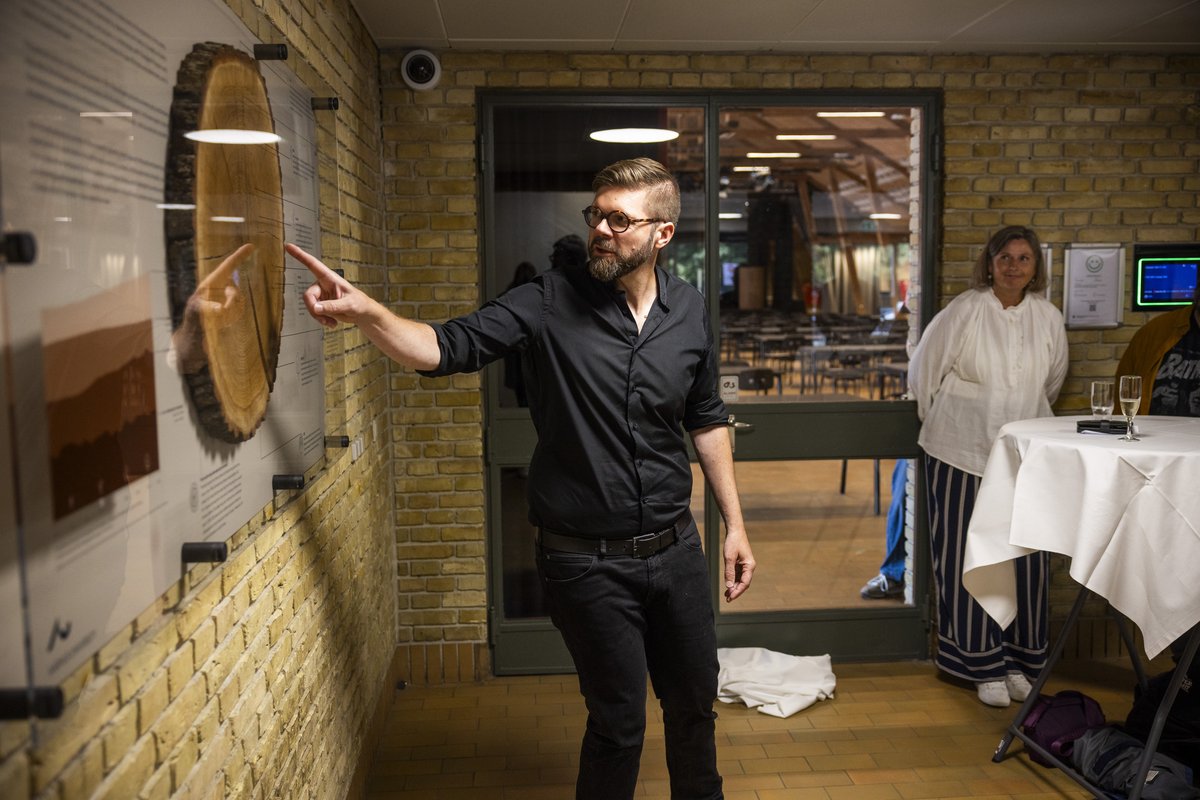
A cross-section of one of the fallen oak trees is now the centre of a new exhibition that hangs in Stakladen's foyer.
”By focusing on the tree cross-section, we have succeeded in bringing together a great many different disciplines from across the university, and in doing so we have gained the many different insights that come from looking at the same thing from a range of academic perspectives,” says Felix Riede, referring to the extensive contributions made by colleagues from many different parts of the university.
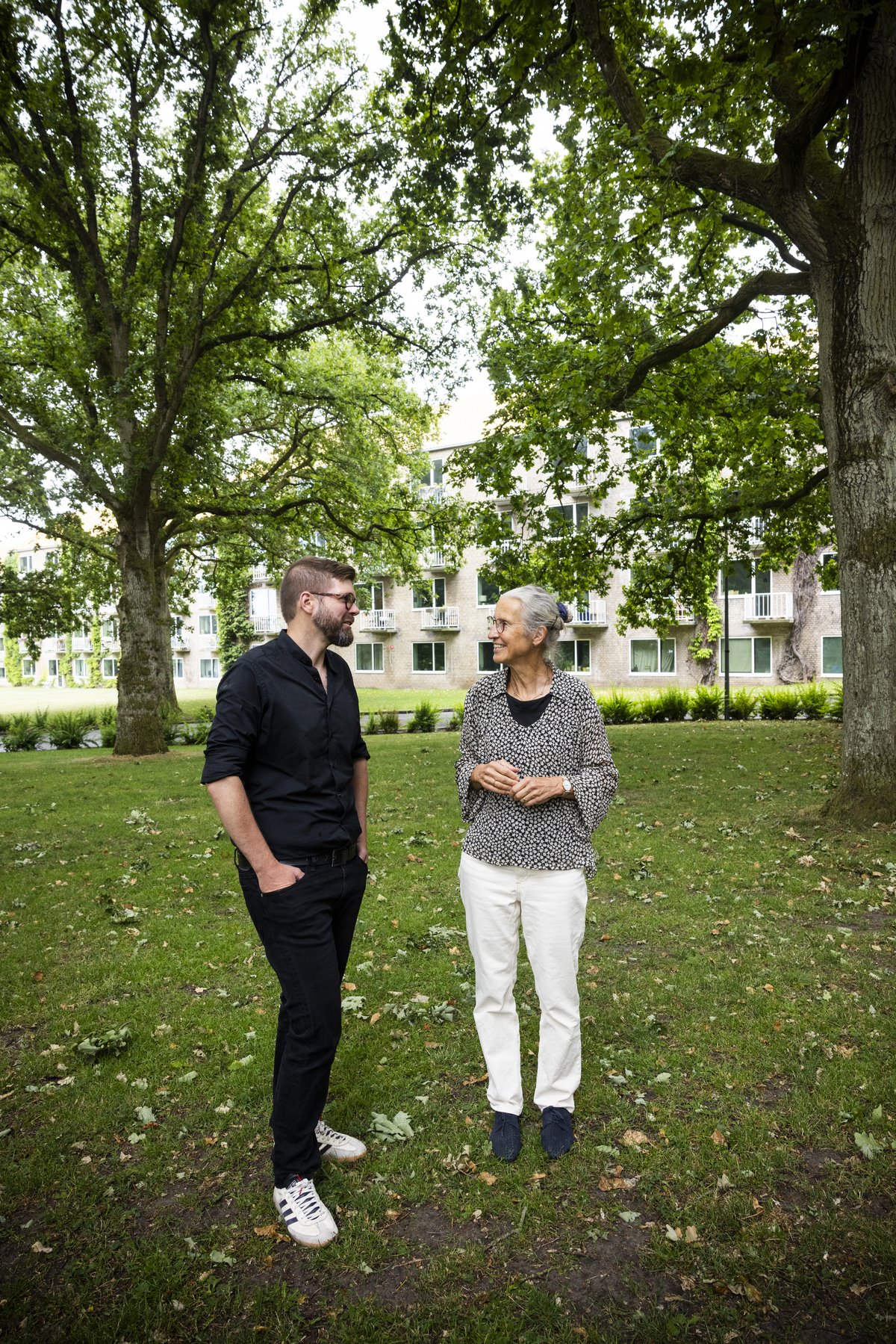
One of the many colleagues who have contributed is Ning de Coninck-Smith, who is a professor of educational history.
"I'm very interested in how universities are created," says Ning de Coninck-Smith, and her contribution to Felix Riede's idea has therefore been to explore the history of the oak trees and the University Park.
Ning de Coninck-Smith has delved into old archives, examined competition projects, studied the historical record, and spoken with the daughter of the architect behind the University Park, one of the leading garden and landscape architects of his time, to uncover as much as possible about the history and origins of the oak trees.
Slight resemblance to Stauning's garden
Carl Th. Sørensen, the creator of the University Park, can be credited with the oak trees and the distinctive way in which they shape the park’s appearance.
"Just before he joined the project with the University Park in Aarhus, Carl Th. Sørensen created Stauning's garden at Bellevue and Klampenborg. Here, there are old, exposed beech and chestnut trees, and it is reminiscent of the way the oak trees are placed in the University Park," says Ning de Coninck-Smith.
The first oak trees were planted at what is now Aarhus University in the spring of 1933. At the time, allotment gardens were being removed to make way for progress and the new university. The City of Aarhus and enterprising Aarhus residents had won the race to become the home of Denmark's first university outside Copenhagen. This was established in 1928, and the municipality donated a piece of land north of the Jutland Maternity Home, a site that had previously served as a gallows hill, then a landfill, and later as allotment gardens. Now it was time to build a university.
"An architectural competition was announced, and one of the requirements was that the university should be a college university, as we know it from Oxford, where the park encloses housing, dormitories, cafeterias and teaching," says Ning de Coninck-Smith.

The three architects behind the university buildings, Kay Fisker, C. F. Møller and Povl Stegmann, asked Carl Th. Sørensen to help with the park. And he did.
"And when the victory was secured, it was decided that Carl Th. Sørensen was to receive an equal share of the prize money in recognition of the University Park’s importance for the project," says Ning de Coninck-Smith.
The master looked to someone else
One of the very special things about the University Park is the hilly landscape, says Ning de Coninck-Smith. Back then, it was fashionable to level the landscape and create straight lines, but that was not what happened here. Carl Th. Sørensen may well have looked to another architect, Fritz Schlegel, for inspiration. Schlegel had already won an earlier gold medal in the Academy's competition for a new university in 1927, several years before Carl Th. Sørensen, and his approach to the park's design was precisely to let it respect the winding forms of the moraine landscape.
In the final competition to design the new university, Fritz Schlegel also participated. He finished third, only to see some of his own ideas come to fruition, but that's another story.
The oak trees grew alongside the university. Once the sheep that had been set to graze the lawn around the trees and who had eaten some of them were removed, things improved, and the oak trees gradually came to occupy their central role in the park.
"For many years, there were still fruit trees in between the oaks that were left after the previous allotment gardens, but a few years ago, the last one was cut down," says Ning de Coninck-Smith.
The cross-section that now hangs on the yellow bricks in Stakladen's foyer can be dated to 1944, and thus it bears witness to almost 80 years of history on campus, in Aarhus, and in the world.
This is something that fascinates archaeologist Felix Riede, and it gave him the idea to use a cross-section of oak wood to link dendrochronology, history, and climate change into one story.
"In a cross-section of oak like this, we’re really dealing with a high-resolution archive. We have different ways of accessing the climate and environment of the past, but if you have the key to this kind of oak cross-section, you have access to a super archive. I think that's cool,” says Felix Riede.
What is dendrochronology?
Dendrochronology, or tree-ring dating, is based on the study of variations in the growth rings of wood. Depending on the annual variations in climate, the tree forms thicker or thinner growth rings. The pattern of narrow and wide growth rings in trees that have grown at the same time in a region will therefore be very similar. In Northern Europe, growth rings from thousands of trees (both living trees and wood from historical buildings and from archaeological finds) have been measured, compared, and dated. In the Nordic region, dendrochronological study is mainly carried out on oak and pine.
Source: Natural Science in Archaeology
He points out that a large number of scientific studies have been carried out in which the chemical traces captured in the growth rings, such as carbon and lead isotopes from the air, have been analysed.
"We can use this to say something about temperature and precipitation in the past; we can also say something about solar storms and nuclear tests, just as we can see when lead was phased out of petrol," explains Felix Riede.
The finished result conveys the broad outlines of the oak trees' coexistence with humans and Aarhus University since the mid-1940s. It is a story of parallel growth, where the university and the city of Aarhus have grown together with the oak trees in the University Park.
"The exhibition also contains a slightly critical perspective on our coexistence. The trees were born in the transition to a new geological period – the so-called Anthropocene epoch – where we humans have a great influence on the development of the planet, and that is not entirely a good thing," says Felix Riede, and continues:
“Some geologists argue that it was with the nuclear weapons tests that followed the end of World War II that we entered a new epoch, marked by extreme pollution, species extinction, and a dark undertone in history, of which we, through the growth of humanity, are a part. At the same time, it's great that the university's many researchers are constantly contributing new knowledge, new solutions, and new innovations to the challenges we face," says Felix Riede, who is both pleased and proud of the new exhibition.
This text is machine translated and post-edited by Mie Skov Jeppesen.