

Record number of students suspended for exam cheating
In 2025, 56 students were suspended for one semester for cheating on exams. This is the highest number of suspensions in 10 years. Omnibus has examined how the scale and nature of exam cheating have changed since 2016. Cheating involving GAI has tripled each year since 2023.

Over the past ten years, the way students cheat has changed. In the past, student cheating often involved plagiarism or unauthorised collaboration. Today, however, GAI and the use of unauthorised aids account for a growing share of the cases recorded. The number of reported cases peaked in 2021, when Covid-19 lockdowns made it necessary to change the format of exams. And 2025 stands out as the year in which the highest number of students were suspended for a semester. This is shown by data provided to Omnibus by AU Student Administration and Services.
In 2025, 209 cases of exam cheating were reported, with students sanctioned in 177 of them.
This is shown by figures that Omnibus has received from AU Student Administration and Services. A total of 56 students were suspended for one semester, which is the highest number of suspensions recorded in the past 10 years.
Table: One-semester suspensions 2016-2025

Aarhus University has gone to considerable lengths to ensure that students are well informed about what is and is not allowed in exams, says Frederik Langkjær, Division Manager at AU Student Administration and Services' department of Quality, Legal Affairs and Admissions.
“AU will not tolerate cheating in exams. It is a serious issue, and it is very important to us that a diploma from Aarhus University reflects what students have learned. It's something people care about. Among university management, teaching staff and students alike. The standards are high, and they should be, because our credibility as a university is a core value,” he says.
Figures from the past 10 years show that the number of reported suspected cases of exam cheating has remained relatively stable, while the number of one-semester suspensions has doubled, from 27 in 2016 to 56 in 2025. At the same time, the figures show that the nature of exam cheating has changed significantly over the period.
At the end of this article, you can see the figures in the overview compiled by Omnibus using data provided by AU Student Administration and Services.
Major shifts over time
The figures should be seen in the context of the thousands of exams conducted at the university every year.
“Before we go into the figures in detail, it is important to note that we actually have very few cases where there is suspicion of cheating in exams. A great many students, indeed the vast majority, sit their exams without cheating,” Frederik Langkjær stresses, noting that between 160,839 and 199,373 exams were held each year between 2016 and 2025, while the number of reported cases of suspected cheating ranged from 108 to 223 annually over the same period.
Table: Number of exams and reported cases of suspected cheating 2016 – 2025

That said, there are some figures and differences that stand out.
Among the most notable changes is the use of one-semester suspensions as a sanction for exam cheating. Between 2016 and 2020, the number of students suspended for one semester for cheating ranged from 13 to 33. From 2021 onwards, between 44 and 56 students a year received this sanction.
During that same period, the number of exams has fallen from almost 200,000 to 166,000.
A number of aggravating circumstances increase the likelihood that exam cheating will result in more severe sanctions, such as suspension for one or two semesters. The list is not exhaustive, and the specific circumstances of each case are always taken into account.
However, cheating in major written assignments such as a Bachelor’s project or Master’s thesis, the use of unauthorised aids, submitting another person’s work as one’s own, extensive copying, and repeat offences are generally considered aggravating circumstances and are therefore subject to more severe sanctions.
Over the past 10 years, there have been no cases of a student being permanently expelled from the university, but the sanction does exist.
The Covid years explain some of it
Part of the explanation can be found in the consequences of the extensive Covid-19 lockdowns, which led to changes in the format of many exams, says Frederik Langkjær, Division Manager at AU Student Administration and Services.
“We altered many exams. Everything was shut down, and we had to change the exam formats very quickly,” says Frederik Langkjær.
In 2020 and 2021, the number of cases involving students suspected of so-called unauthorised collaboration increased significantly.
Table: Unauthorised collaboration 2016 – 2015

Unauthorised collaboration can range from students sharing notes to directly collaborating on exam assignments, something that became possible as a result of the lockdowns and the changes made to exam formats.
“During that period, teaching staff became highly alert to cheating because the rules were new, while many students, for the same reason, were uncertain about what the rules actually were. We see the figures from the Covid period as the result of a combination of those two factors,” says Frederik Langkjær, pointing out that the figures returned to pre-pandemic levels in 2022.
GAI has entered the picture
The many changes brought about by the Covid years resulted in greater vigilance among teaching staff. That has been maintained ever since and may help explain why the use of one-semester suspensions as a sanction has increased in the years since the pandemic.
“There are ongoing discussions about our sanctions policy, and since the pandemic there has been a renewed debate about cheating and sanctions, combined with the emergence of new technology,” says Frederik Langkjær.
The newest factor in all this is, of course, AI, artificial intelligence, generative AI, or simply GAI.
The first seven cases involving suspected GAI-related cheating were reported in 2023. That number tripled in 2024 and has tripled again in 2025.
Table: Suspected cases of GAI-related cheating 2016 – 2025
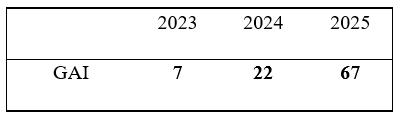
“There is no doubt that the use of GAI is increasing, and so too is the number of cases involving GAI-related cheating. Not just here at AU, but across the entire education sector, and that has sparked extensive debate about how GAI should be integrated into teaching and assessment. The challenge is to allow the use of GAI without compromising the credibility that our degree programmes and students’ diplomas are meant to guarantee,” says Frederik Langkjær.
In 2024, when the number of GAI-related cases surged for the first time, there was also an equally sharp increase in the number of suspected exam-cheating cases that were ultimately dismissed.
Table: Dismissed cases 2026 – 2026

“2024 is the first year we really began to see GAI, and it has been a challenge. Both teaching staff and students have been uncertain about how GAI can be used, and as a result, many more cases have been reported on suspicion of cheating. AU does not tolerate exam cheating, but students are also entitled to due process. With new technologies, it can be more difficult to understand the rules, and there may be uncertainty about what is permitted,” says Frederik Langkjær, explaining why so many cases were dismissed in 2024.
“As frameworks for the use of GAI are put in place, the number of reported cases of suspected GAI-related cheating begins to fall again. The uncertainty disappears, and so do the cases of unintentional cheating, where students have not set out to cheat,” he continues.
Case-by-case assessment
The analysis of the data cannot determine how many cases involving GAI-related cheating result in sanctions.
“It is difficult to go into detail about sanctions for exam cheating, because each case is assessed individually. But there are of course some overarching principles in the way we assess the seriousness of cheating,” says Frederik Langkjær and continues:
“GAI can be used for many different forms of manipulation, including some of the types of misconduct that we typically sanction quite severely, such as the fabrication of data. If you copy from your own previous work, it is conceivable that the sanction would be less severe than if GAI had generated part of the assignment. However, it always comes down to an individual assessment of the specific case.”
Frederik Langkjær says that GAI-related cheating can also be difficult to detect, as it requires greater vigilance on the part of teachers and co-examiners.
“It may be that the language in an assignment suddenly changes or that the tone shifts. If the teachers know the students and their language well, this kind of thing will be noticed. It may also be that there are non-existent references, or that sources are incorrect or used incorrectly. But it is difficult,” says Frederik Langkjær.
Far less plagiarism
While the number of cases involving GAI-related cheating continues to rise, the number of cases of good old-fashioned plagiarism is falling correspondingly.
When compiling its statistics, AU Student Administration and Services classifies three different forms of cheating as plagiarism.
“Plagiarism” refers to cheating by, for example, using text taken from another source without acknowledging it. “Another person’s assignment” refers to the use of text from an assignment written by someone else without acknowledging it, while “Own assignment” refers to cheating in which a student reuses text from a previous assignment of their own without indicating this in the exam paper.
“Once an assignment has been submitted and assessed, text from it may not be reused unless it is clearly referenced as material taken from a previous assignment. You actually have to cite yourself, and that is one of those forms of cheating that can be a little difficult for students to understand,” says Frederik Langkjær.
Table: Plagiarism 2016 – 2025

Clear development over time
When all types of exam cheating are considered alongside the number of cases and trends over time, a clear picture emerges.
In 2016, cases involving plagiarism, unauthorised collaboration and other forms of misconduct (such as the shared use of notes and the uploading of exam answers from home for an on-site exam) were by far the most common, accounting for 170 of the 233 cases reported. By 2025, the most common categories were GAI, unauthorised aids and the use of another person’s assignment, which together accounted for 145 of the 209 reported cases.
“This development shows how cheating has evolved in practice, but it also shows that there were actually more cases of suspected cheating in 2016. The figures have remained fairly stable over the years, despite the arrival of new technology and changes to various exam formats,” says Frederik Langkjær, Division Manager at AU Student Administration and Services.
The figures are put to use
The figures on exam cheating are not compiled solely to give AU Student Administration and Services an overview of the scale of the problem.
The annual figures are shared with the academic environments across the university, where AU Student Administration and Services also seeks opportunities to discuss exam cheating and the trends highlighted by the data.
“We also report to the Education Committee and look at whether there are new trends, such as GAI, that we as an institution need to be aware of, so that this can be brought to the boards of studies and become part of the discussion about exam formats and the requirements placed on students. That falls within the responsibilities of the boards of studies, and they are responsible for making those decisions,” says Frederik Langkjær.
Cases of exam cheating are assessed individually by AU Student Administration and Services, and any sanction recommended by the department is always based on a case-by-case assessment of the specific circumstances involved. Ultimately, however, it is the Dean’s Office that decides on the sanction.
Frederik Langkjær explains that in addition to the sanctions themselves, there is also a focus on ensuring fair and equal treatment of students across faculties and degree programmes.
“The Education Committee continually monitors sanctions levels to ensure that students are treated equally, regardless of which degree programme they are enrolled in. Of course, there are differences from one degree programme to another because the courses, teaching and exams differ. However, we make sure that sanctions are applied consistently, so that a student is not suspended in one place for an offence that would only result in a warning elsewhere,” says Frederik Langkjær.
Table: Overview of figures 2016 – 2025
