

Yes, you can be a PhD student with a mental health diagnosis – but it is vulnerable
Educational anthropologist Sine Lysdahl Jensen is a PhD student at Arts, where she researches how the physical environments of universities affect students with psychological vulnerability. A subject she knows first-hand, as she herself has a mental health diagnosis. A position that makes her both proud - and vulnerable.

Sine Lysdahl Jensen has a story she wants to tell. It’s very personal, but it’s also closely linked to her professionalism, and makes her both very proud and vulnerable. After careful consideration, she has decided she will share it.
"I think many students with a diagnosis feel alone with it. By standing up and talking about my individual challenges and experiences, I can help to provide a more balanced view of the fact that it’s possible to be a student and a PhD student with a disability.”
Sine Lysdahl Jensen also hopes to help nuance the image of what it means to have a disability.
"It’s a very individual experience, and if the university is to become better at helping and supporting students with disabilities, it requires individual solutions rather than one-size-fits-all solutions, where a specific diagnosis triggers a specific type of support."
Sine Lysdahl Jensen is a PhD student at DPU at Arts, where she’s part of the project 'Inclusion in higher education through design of multiple student pathways', and she researches the inclusion of students with disabilities in institutions of higher education.
"My specific project is about how students with affective disorders navigate the university world. I am very interested in how different places influence the experience of inclusion or exclusion. Places and spaces are never neutral; there’s always a value or norm associated with them, and I am curious about how university places or spaces either reinforce or reduce the experience of anxiety, depression or bipolar disorder," she says.
Openness as a strategy
When Sine Lysdahl Jensen applied for the PhD scholarship, she was open about the fact that she has a mental health diagnosis that can result in anxiety, hyperactivity and depression, and which at times has a profound impact on her way of being in the world, as she puts it. The fact that she received the scholarship despite this made her extremely proud and happy. But at the same time, she and her loved ones were going through a difficult period because a close family member was seriously ill. Being emotionally torn between joy and anticipation on the one hand and sorrow and despair on the other was so contrasting and exhausting for Sine Lysdahl Jensen that it resulted in sick leave.
Sine Lysdahl Jensen's aim is precisely not to paint a rosy picture of combining a mental health diagnosis with a PhD programme as uncomplicated. It's far from it. But for Sine Lysdahl Jensen, one of the strategies that will make it easier is to be open about her diagnosis.
"When you keep it inside, it takes a lot of energy to control and try to fit in. By talking openly about it, I hope I won't have to struggle so hard to hold on to it," she explains.
However, not everyone in her department is aware of her situation yet, she says.
"But it's not a secret, and I'd rather people ask me about it out of curiosity than have them imagine how it must feel or constantly assess my condition," she says.
But it’s a relatively new strategy, she admits. During her Master's degree programme, she didn't tell anyone.
"I couldn't handle it," she explains.
Academic by a roundabout route
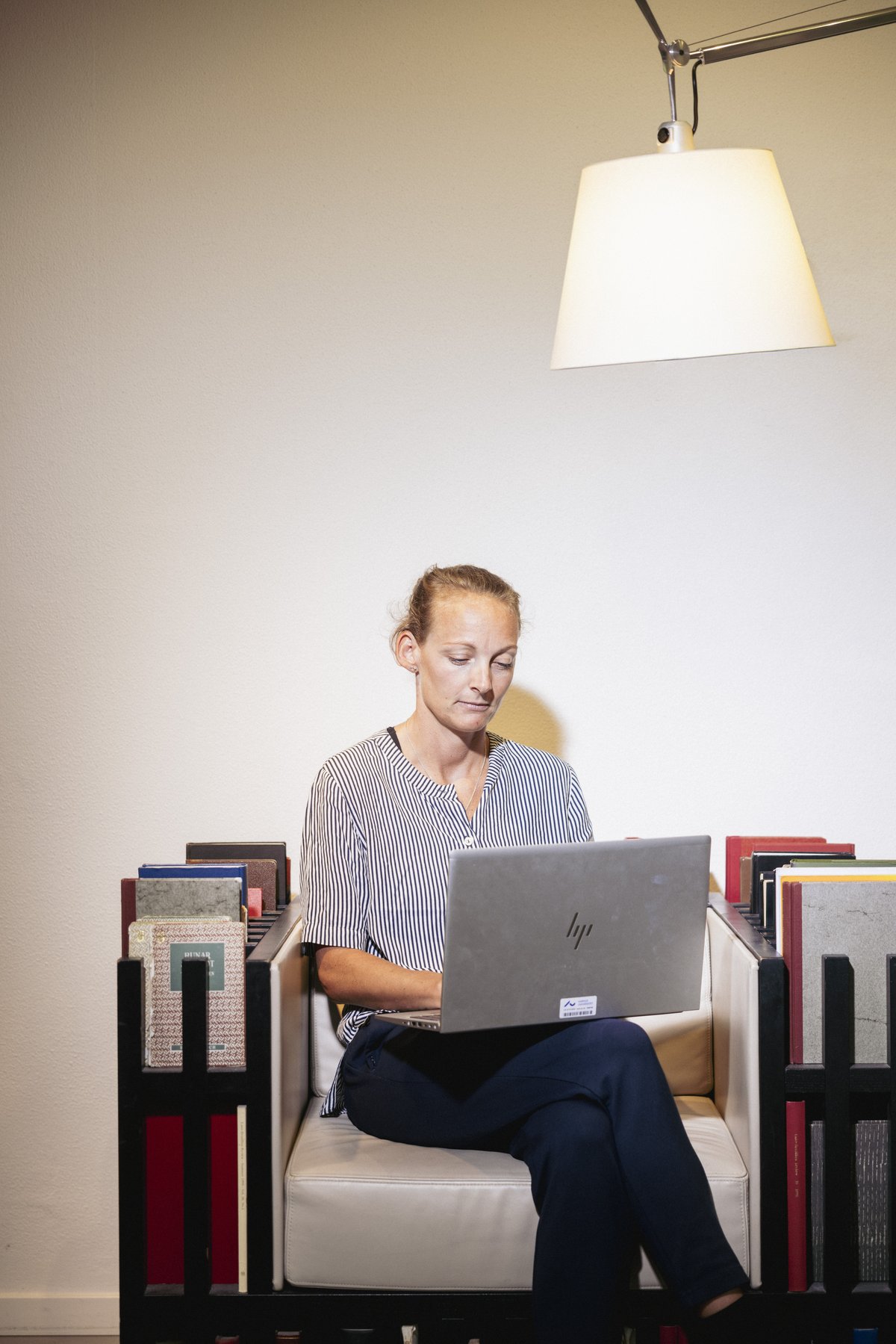
It wasn’t in the cards that Sine Lysdahl Jensen would pursue a university education and later a PhD scholarship. She describes upper secondary school as 'awful'; academic subjects meant nothing to her, and her grades were at the bottom of the scale. In return, she was a surfer on the Danish national team.
"I have always enjoyed using my body and have practised several sports at an elite level," she explains.
After upper secondary school, Sine Lysdahl Jensen tried to pursue a career as a professional windsurfer. But that was before the discipline became part of the Olympics, so it was more than difficult to make a living from it. She then applied to the Danish Armed Forces, first as a conscript and then at the Sergeant School, where she was initially a sergeant trainee and later appointed sergeant.
"I had so much energy and needed to use it, and to be challenged and gain discipline," she says.
Shortly afterwards, she became ill with depression and was assessed and given a mental health diagnosis.
"At first, I couldn't see myself in a diagnostic box, but the more I talked to psychiatrists and nurses, the more I could relate to what they were saying. I myself had a rather limited and prejudiced approach to mental health disorders," she says.
After a long period of sick leave, she left the Danish Armed Forces and worked for some time as an event coordinator before applying to the social education programme. There she met a teacher who played a crucial role in her being at the university today.
During my social education programme, I was introduced to theory and anthropology. There, I discovered that academic studies were really interesting, and I was encouraged to pursue my curiosity. There was a teacher who saw me, and that I was capable of something. I had never experienced that before.”
The lecturer encouraged Sine Lysdahl Jensen to read philosophical and anthropological works, thereby helping to open her eyes to the Master's degree programme in educational anthropology.
"I had no idea that was a possibility. I come from the countryside, from a home where there were neither books nor big words. I didn't know anyone who had studied at university, and I never thought that academia was for me – that I could do it," Sine Lysdahl Jensen says.
Physical locations can trigger disorders.
Sine Lysdahl Jensen draws heavily on her experiences as a Master’s degree student with a mental health diagnosis in her current research project.
For example, she found it challenging to move from the Nobel Park, where she had worked hard to feel secure, to a completely new environment at the Support and Counselling Centre in connection with SPS counselling (special educational support, ed.).
"It would have been much more useful for me if the guidance could have been provided online or in the environment I was part of daily," she says.
I also encountered the attitude: 'Someone like you needs structure'. But I had a structure that was just different from everyone else's," she explains.
In the end, she decided not to apply for SPS support during her studies.
"The experience has made me curious about place and space – and how it can trigger disorders," says Sine Lysdahl Jensen, emphasising that it’s not her disorder that is the focus of the project:
"But the bodily experience I have can open up some reflections. I’d like to investigate the strategies that students with affective disorders use to be able to function in the university environment. Both the physical spaces and the more abstract value-based spaces."
Based on her own experiences, she considers it "insane" that the university has established an examination centre in Lisbjerg, which is completely disconnected from the university and therefore not part of the students' everyday lives.
"If I had to go somewhere completely different to take my exams, I’d be completely..." she throws her arms up in despair.
The right place
While Sine Lysdahl Jensen didn’t benefit greatly from the university's SPS counselling as a Master's degree student, the situation is different now that she is a PhD student, and she finds it to be a useful support.
"For example, we work on how I can maintain control in different situations," she explains.
In addition, she focuses on achieving the right balance between being under-stimulated and over-stimulated.
"It's about allowing myself to pursue abstract ideas, but at the same time being mindful of eating, getting enough sleep, exercising, taking breaks and following my treatment plan. It's something I constantly have to deal with to feel comfortable being somewhere. I have to constantly regulate myself.”
In addition to SPS, Sine Lysdahl Jensen has also benefited greatly from talking to the university chaplain, she says. Among other things, they have discussed suffering as a human condition. In the period leading up to her sick leave from her PhD programme, there were several incidents that Sine Lysdahl Jensen found painful and shameful to experience and think back on.
Although she is now feeling well again, she knows that she will probably face more challenges along the way during her PhD studies. But here she can draw on all her experience from the Danish Armed Forces, her time as an elite athlete and her trials at the university.
"I know I can be pushed, but I also know that I can achieve whatever I set my mind to," she says.
"I consistently feel that I am in the right place, where I can pursue my curiosity and be intellectually challenged and stimulated; it just requires a little extra effort for me to navigate this system."
Sine Lysdahl Jensen hopes that by sharing her story, and especially through the research project she is part of, she can contribute knowledge and experience that will make it easier for students with special needs to feel included.
"You can't change every room, but inclusion is also linked to flexibility. Not only in terms of teaching and exams, but also flexibility in terms of frameworks such as architecture, community, interactions with teachers – in other words, overall flexibility and curiosity and openness about individual needs.”
This text is machine translated and post-edited by Lisa Enevoldsen.