

Red Bull pushes the boundaries at AU
Friday bars, dorm parties, and lectures. The energy drink Red Bull is appearing everywhere on campus, and the massive exposure during the Regatta helps to connect the mega-brand to the university, according to two experts. The university director will now discuss with the senior management team whether the limit has been reached – the director has also contacted Red Bull directly.

Around 37.000 students spend their daily life at Aarhus University, and this makes the campus appealing to everything from trade unions to private companies that want to get in touch with the attractive target group.
One company in particular stands out from the rest. An Austrian energy drink company seems to be popping up everywhere, culminating with the Regatta, where the entire University Park is wrapped in the Red Bull logo.
Red Bull gives the Regatta wiiings
Students are attractive
The fact that university students are an attractive target group for a company like Red Bull is far from coincidental, believes Trine Susanne Johansen, associate professor in strategic communication at the School of Communication and Culture.

“It is attractive for Red Bull to be present in settings focused on performance. Red Bull's athletes are among the elite in their field, and here is the link to society's elite at institutions of higher education like a university," explains Trine Susanne Johansen.
On their website, Red Bull writes that they are "valued worldwide by top athletes, students and in demanding professions..."
“If there is any space focused on performing and living the 'right' life, which produces the 'right' CV, which gives access to the 'right' jobs, it is the university. The story of the ambitious, outgoing, creative, and social student fits perfectly into Red Bull's own story, and thus Red Bull can support the student lifestyle," explains Trine Susanne Johansen.
Massive marketing
The marketing aimed at young, ambitious university students is highly structured. Worldwide, around 4,000 university students are employed by Red Bull to promote the product to their peers.
These are called 'Student Marketeers' and are also found on campus in Aarhus, where they are tasked with organizing events, increasing awareness of the product, and placing Red Bull in as many places on campus as possible, preferably in connection with social events.
The job as a student employee at Red Bull requires, first and foremost, that you be active, social, and approachable towards other influential students and events on campus, according to the job description.
Omnibus has collected examples of how this work is carried out in practice. And there are a lot.
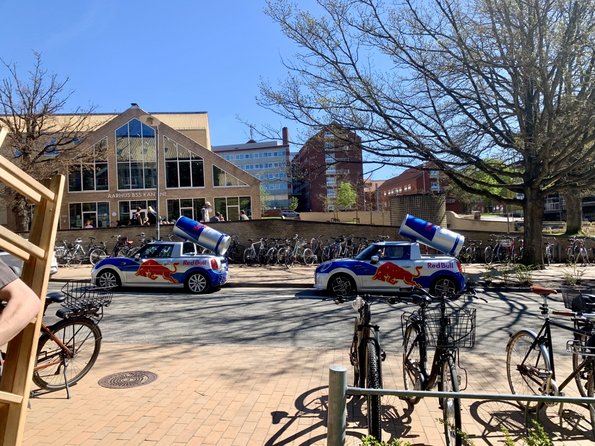
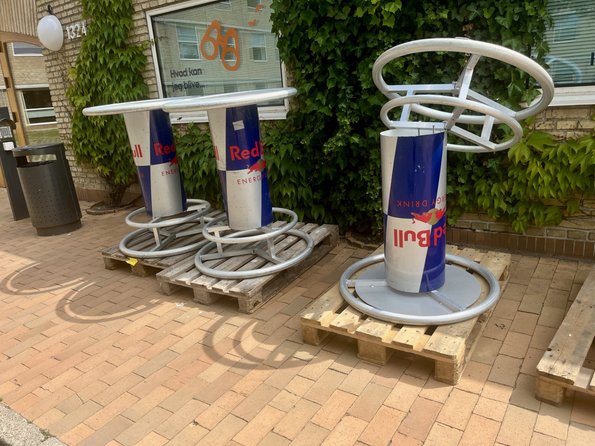
The characteristic Red Bull MINI Cooper is often parked visibly on campus, preferably in places where there are many students. Here, students in Red Bull clothing hand out free energy drinks in connection with lectures and Friday bars. It may also be the case that a student receives a whole box of Red Bull for free, which can be shared with lucky fellow students. There are countless examples of Red Bull showing up with free supplies of energy drinks at dorm parties, and in several Friday bars, drinks are served in Red Bull cups, and on sunny days, the drinks can be enjoyed under Red Bull umbrellas. Energy drinks are distributed when there are activities in the University Park, brightly coloured cans are placed in bicycle baskets, and the editorial team is aware of a few examples of lectures being interrupted because a student has won a box of Red Bull that is to be handed out in front of all the other students.
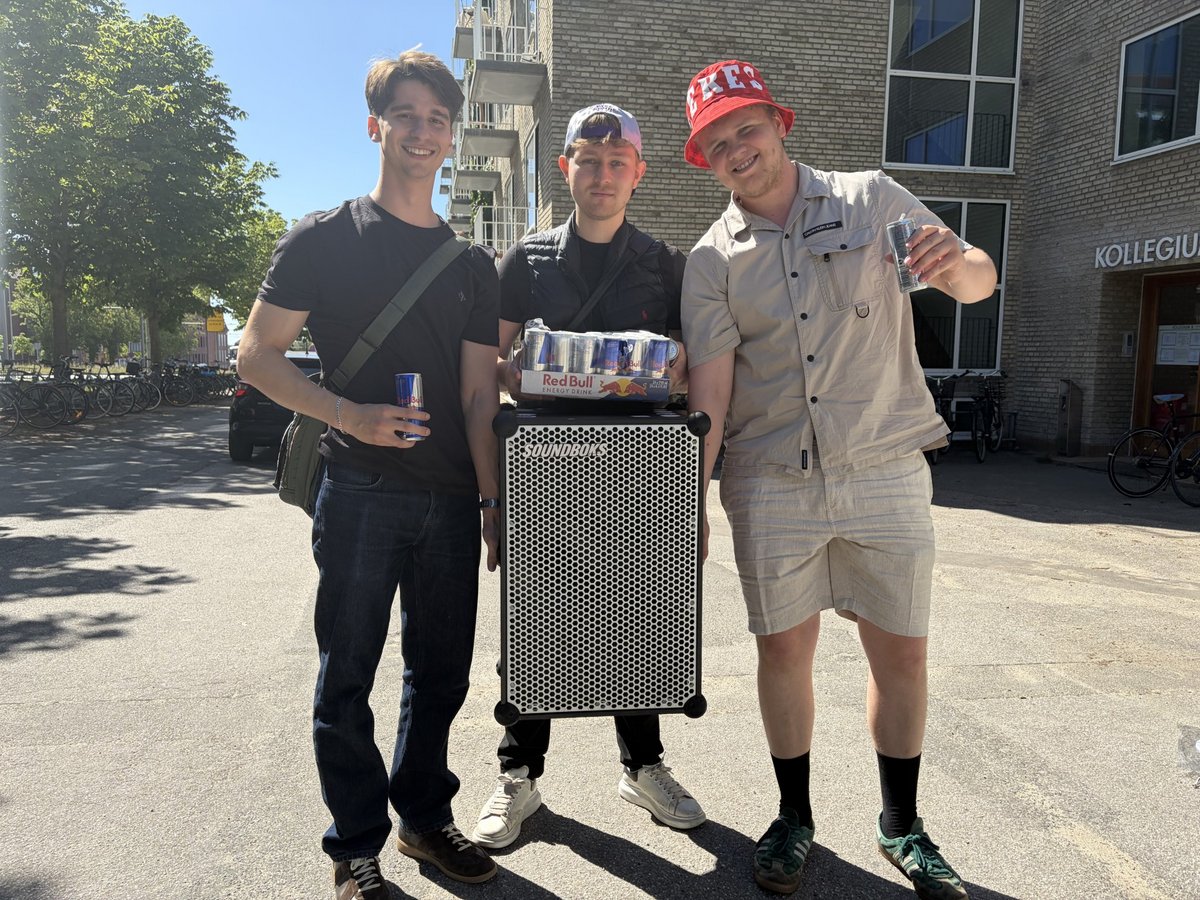
"By showing up on campus and handing out the products in all possible contexts, Red Bull achieves great visibility and recognition, and thus enormous advertising value," says associate professor of strategic communication, Trine Susanne Johansen, and continues:
“And then there’s the fact that it’s fellow students who hand them out. This strengthens the commercial relationship, which also gets a tinge of a social relationship between the product and the customer. That is one of the most valuable things for a brand. Red Bull pays hourly wages to students who are already familiar with the social contexts and events on campus, and as brand ambassadors, they create a lot of attention and contact with their fellow students.”
Clearly crossing the red line
There are clear rules for what a private company can and cannot do at Aarhus University. This is emphasised by University Director Kristian Thorn.

Red Bull in a nutshell
The story of Red Bull begins in Thailand, where Austrian Dietrich Mateschitz discovered the energy drink Krating Daeng, which Chaleo Yoovidhya had developed to sustain the energy of hard-working Thais.
The two joined forces, adapted the product for the Western market, and launched the first Red Bull in Austria in 1987. In practice, it was the foundation for a completely new market.
Since then, the company has primarily grown through unconventional and innovative marketing and through extreme sports, motorsport, music, events, and various sports clubs.
Today, Red Bull is one of the world's most well-known beverage brands. In 2025, they had just under 22.000 employees, activities in 178 countries, and sold almost 14 billion cans of energy drinks.
The company is still controlled by the two founders, who are currently estimated by Forbes to have a fortune of around 45 billion USD.
“There is a clear limit to what you are allowed to do as a commercial actor, and that limit is reached when you disrupt the university's activities. Then you're crossing a red line," says the university director, referring to the examples of lectures being interrupted by the handing out of Red Bull.
“Based on the examples Omnibus has presented where lectures have been interrupted, I have written to Red Bull and asked them to change their practice. We do not accept that our activities are interrupted or hindered, and we expect them to comply and refrain from such actions. Otherwise, we must take further steps regarding companies,” says Kristian Thorn.
Capitalising on performance-focus
According to Trine Susanne Johansen, Red Bull markets much more than an energy drink. The company markets “The Red Bull Way of Life,” where you “gain wings” and can perform at a high level. The professional athletes in Red Bull's portfolio are examples, but at the universities, Red Bull emphasizes that you can also gain wings in your life as a student, says Trine Susanne Johansen.
Red Bull is among the best in the world at hitting a target group with the message that a given product can really make a difference in their life, says Anders Schmidt Vinther, who is a teaching associate professor and PhD at the Department of Public Health. For several years, he has given talks on energy drinks and performance-enhancing substances amongst young people to municipalities.

He says that, like coffee, energy drinks have an invigorating effect, but he does not believe that consuming energy drinks in itself is harmful to such an extent that it should set off alarm bells across campus.
When Anders Schmidt Vinther nevertheless questions the use of energy drinks in connection with the university and students, it is because Red Bull, like the popular electrolytes and various other products in the dietary supplement industry, hits right into society's focus on optimization.
“Universities are trying to combat loneliness and unhappiness. I don't think energy drinks are contributing to the problem, but Red Bull in particular is good at capitalizing on society’s current focus on performance by marketing themselves as something you need because you need to optimize yourself and perform, explains Anders Schmidt Vinther.
“The question is whether this is the kind of company that you, as a university, want close to you as part of the campus.”
Methods go under the radar
In recent years, Red Bull has taken over the campus and expanded its presence, for example, through the aforementioned student marketeers.
Associate Professor, PhD in Strategic Communication, Trine Susanne Johansen describes Red Bull's marketing strategy as a mix of guerrilla- and stealth marketing.
“The brand will appear suddenly in a very visible and large-scale way and then disappear again. Then they show up somewhere else, and it all repeats itself. That way, they kind of go under the radar, and the individual event where Red Bull hands out 500 cans to tired students before a late lecture may not mean much to the target group. But overall, Red Bull has a significant presence at the university, she explains.
The distinctive presence plays a crucial psychological role in the strategy, which few people are aware of, explains Susanne Pedersen, an associate professor at the Department of Management and researcher in consumer behaviour and consumer psychology.

“Red Bull's marketing strategy is designed precisely to break down our critical systems to the point where we completely stop questioning their presence on campus. Now it seems completely normal that Red Bull is here as part of campus life," she says.
The first time Susanne Pedersen herself became acquainted with Red Bull on campus was a few years ago.
“One of the students brought a whole box of Red Bull to class. He had received it for free so that he could distribute it to his fellow students.”
“Today it seems to be more normal for students to need a boost during the day and therefore bring an energy drink to class, drinking it wherever and whenever it suits them,” says Susanne Pedersen.
The brain’s decision-making systems
Psychologist Daniel Kahneman is known for his work on evaluation- and decision-making psychology.
In his theory of the brain's decision-making systems, he describes two different ways in which humans make decisions:
System 1 is in charge of quick and intuitive thinking, and is characterized by functioning automatically and unconsciously. Only minimal effort is needed, and the system is responsible for quick and intuitive reactions. System 1 uses so-called heuristics, mental shortcuts that help us make decisions quickly based on previous experiences and pattern recognition.
System 2 takes care of the slow and analytical thinking, which requires focus, conscious and analytical effort, and greater mental exertion. System 2 takes over when we are faced with a complex issue that requires consideration and reflection, risk analysis, and evaluation of consequences. This system is slower and more careful than system 1.
Dampens critical thinking
Red Bull gives wings to people and ideas, the company writes about itself. It's fun, exciting, challenging, and evolving to be part of ‘Red Bull's Way of Life'.
That message and the positive stories of great achievements, combined with massive presence and exposure, is the perfect strategy, psychologically speaking, according to Susanne Pedersen.
“Mentally, we don't have the energy to assess and decide on everything all the time. As a result, we have developed two systems that help us make decisions. "System one takes care of the small, quick, impulsive decisions that are not associated with major consequences, but system two takes care of the larger decisions that are based on thorough consideration, evaluation of consequences, and risk analysis," she explains.
According to Susanne Pedersen, Red Bull uses this knowledge to bypass system two without the students even noticing. She believes that Red Bull patiently and persistently dampens the students' ability to critically assess what they really think about the product and that the constant exposure directly primes the brain to not only accept Red Bull but also to prefer it over other energy drinks.
“Red Bull constantly creates situations where the brain is not aware that it needs to be on guard. The students are constantly given the fun, colourful story of how amazing Red Bull is, combined with a free can. This triggers emotions, and over time, the attitude towards the product is affected," explains Susanne Pedersen, referring to research showing that when we as humans are repeatedly exposed to the same thing, it has an effect and makes us more positively inclined towards it.
This phenomenon is well described in research and is called the mere-exposure effect.
Mere Exposure Effect
The mere-exposure effect is a psychological phenomenon where people often become more positively inclined towards something simply because they encounter it repeatedly.
The first known theory of the effect was presented by the German physicist and philosopher Gustav Theodor Fechner in 1876, but it was especially the social psychologist Rebort Zajonc who documented and described the effect in the 1960s.
The basic idea is that people associate something familiar with security, credibility, less risk, and greater sympathy. The effect has been documented across a wide range of exposure types, including people, logos, slogans, products, faces, and ideas.
There are several explanations for why this happens. Processing fluency explains that previously encountered information is easier for the brain to process. It flows more easily and is perceived by the brain as less demanding.
Another element is the idea that the unknown is evolutionarily perceived as more dangerous than the familiar, which is why a preference for the familiar arises.
“Emotions are mental shortcuts. Exposure to funny commercials, good experiences, free energy drinks, and inclusion in a universe where everything is possible and where dreams can be lived out results in a mental shortcut in the brain: Red Bull = good,” sums up Susanne Pedersen.
A grey area
While there are clear red lines for what Aarhus University will accept regarding the actions of commercial actors on the university's premises, the lines are not quite so clear outside of them, notes University Director Kristian Thorn.
“When it is not about specific violations of our rules and red lines, we are moving into more of a grey area. The students are adults who are used to living in a society where advertising and other forms of commercial influence also exist," says Kristian Thorn, stating that there is a difference between the areas that fall under the university, and where the university's activities must take place undisturbed, and the public areas such as the University Park.
"In public spaces, students have to tolerate a great deal, as in the rest of society, as long as it is legal and concerns a legal product," says Kristian Thorn.
And yet not entirely, because there are cases where it is not fully up to the students what they want to accept. Sometimes, the exposure of a commercial actor may be of such a nature or become so great that the senior management team may intervene.
“Here, it is about the academic and social study environment. We really care about this, we are proud of it, and we want to take great care of it," says the university director.
The Regatta is a major boost for the study environment
The academic and social study environment is developed and cultivated to a great extent in the many associations on campus. Among the more than 400 associations are the student social committees, which are particularly large and visible, and here Red Bull is also active.
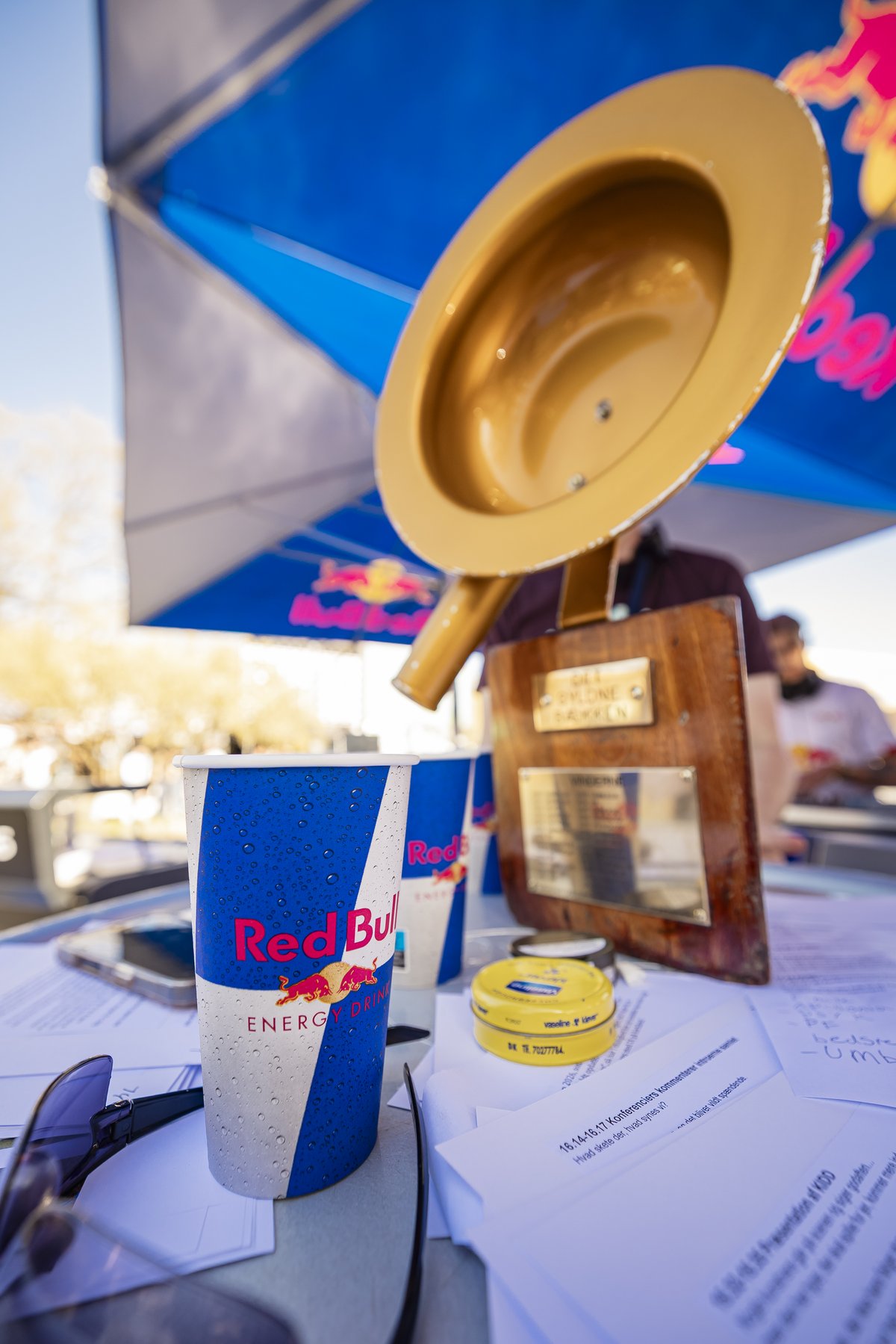
Especially in connection with the Regatta, where the Red Bull logo and energy drinks are everywhere in the University Park.
The race is described as the largest student-run event in the Nordic Region, with around 30.000 students gathered to celebrate and to determine who can paddle and drink their way to the Golden Bedpan the fastest.
When the university brands itself to prospective students, it uses the Regatta as an example of the study environment that the university director highlights.
During this year's edition at the end of April, the Regatta and Red Bull were hard to separate.
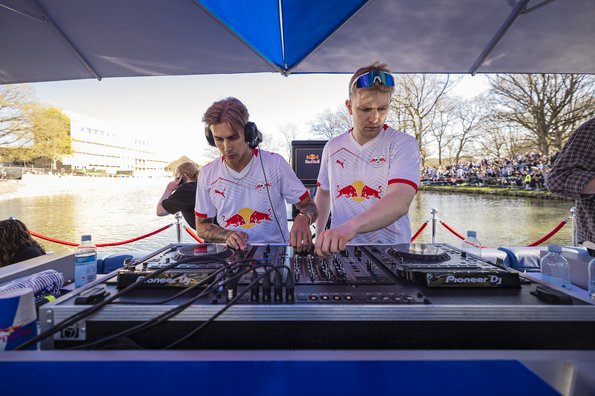
During the 2026 Regatta, Red Bull was everywhere. On the raft in the middle of the lake, and on floating advertising cushions, which are featured in virtually all the images that were spread through local, regional, and national media, as well as the countless reels, snaps, and stories that were sent out into the world from the University Park that day.
The DJs playing had Red Bull written on them. Red Bull was on almost every cup and drink carrier, and there were tents from Red Bull in every corner of the University Park with Red Bull lounges. There were Red Bull cars with their own DJs and servings of yes... Red Bull, and even on the big screens, were advertisements that said ‘Red Bull gives wiiings.
Links Red Bull to Aarhus University, experts say
Umbilicus is the organiser of the Regatta, and as an association, it constitutes a separate legal entity under the Constitution, making it independent of Aarhus University.
But associate professor of strategic communication Trine Susanne Johansen questions whether the Regatta can be considered as independent of the university, as the association that organizes it.
"It takes place with the support of the university, and on the university's premises, and the Regatta is even used in the university's own marketing towards prospective students," notes Trine Susanne Johansen and adds:
"When the Regatta is linked to Aarhus University as an institution, then even though it is independent on paper, the senior management team has an interest in how the event appears."
Associate professor and researcher in consumer psychology and consumer behaviour, Susanne Pedersen, shares the same conviction.
“AU must have somehow given permission for the Regatta to collaborate with Red Bull to this extent. I can't believe otherwise. Therefore, AU is also accountable for what is happening," says Susanne Pedersen, who finds it difficult to imagine that Red Bull will hold back on its massive exposure.
“I'm not sure that the exposure can become too much for the students, exactly because the story of Red Bull deals with the extreme and performance,” says Susanne Pedersen.
The university sets requirements
University Director Kristian Thorn admits that the relationship with commercial actors such as sponsors and partners becomes "more vague" in connection with the work of student associations.
Aarhus University has written rules governing sponsors operating under the university, but in principle, it is the student associations that are responsible for the relationship with their sponsors and partners.
The university itself is a partner because most student activities, such as Friday bars and the Regatta, take place on the university grounds and must therefore comply with the same rules as everyone else who is allowed to use, for example, the University Park.
Kristian Thorn recognizes the great work the student associations do for student life on campus and, as part of the senior management team, wants them to enjoy a high degree of freedom, provided they operate within the rules that apply to everyone.
However, the university has intervened previously. For example, when the Regatta received a large sum of money from the tobacco industry just over 10 years ago.
AU contributes 230.000 DKK annually to the Regatta, according to a framework agreement with Umbilicus. The money must be used for sanitation and electrical work expenses, otherwise it has to be paid back.
It is also stated that the money is contingent on Umbilicus entering into sponsorship agreements related to the Regatta ‘with ethical and climate considerations in mind’.
The university cannot prohibit the Regatta and Umbilicus from cooperating with specific companies, but it can, in financial terms, pull the rug out from under the event by withdrawing its own sponsorship as a consequence of Umbilicus’s cooperation with a private actor, should it come to that.
“We collaborate closely with the student associations and are constantly in dialogue. We do not want to be limiting or restrictive, and we experience that the student associations navigate the fairly large degree of freedom they have," says the university director.
AU management will discuss the balance
That said, he acknowledges that Red Bull's presence on campus is large and that the information presented by Omnibus requires that the senior management team address the pressure from commercial actors against the university and the students.
“This case calls for reflection on whether we have the right balance. This does not apply specifically to Red Bull but to any commercial activity and brand. It’s about when it overshadows our core purpose as a university,” he says, continuing:
Due to the attention that has now been drawn to a particular actor’s presence on campus, I will take the initiative to discuss within the senior management team whether we have the right balance,” says Kristian Thorn, stressing that this does not necessarily mean that new rules or guidelines will follow.
"As mentioned, we have a close dialogue with the student associations, and we would rather solve things through dialogue than make new rules," concludes the university director.
Omnibus has been in contact with Red Bull, who does not wish to participate.
This text is machine translated and post-edited by Mie Skov Jeppesen.