

Students are not expected to know the evacuation concept
Fire protection: Omnibus has investigated what students know about the emergency response and evacuation concept at Aarhus University. The results show that awareness is low, but that is to be expected, says the emergency response coordinator.
![[Translate to English:]](/fileadmin/_processed_/9/2/csm_csm_Anders_Moestrup_4b72482518_f3187f9665.jpg "[Translate to English:]")
Only one in four students has heard of the university's evacuation procedure. And only two out of 100 students have seen the short film that the university has produced about what will happen if evacuation becomes necessary.
This is shown by a survey conducted by Omnibus among 129 students on campus in Aarhus.
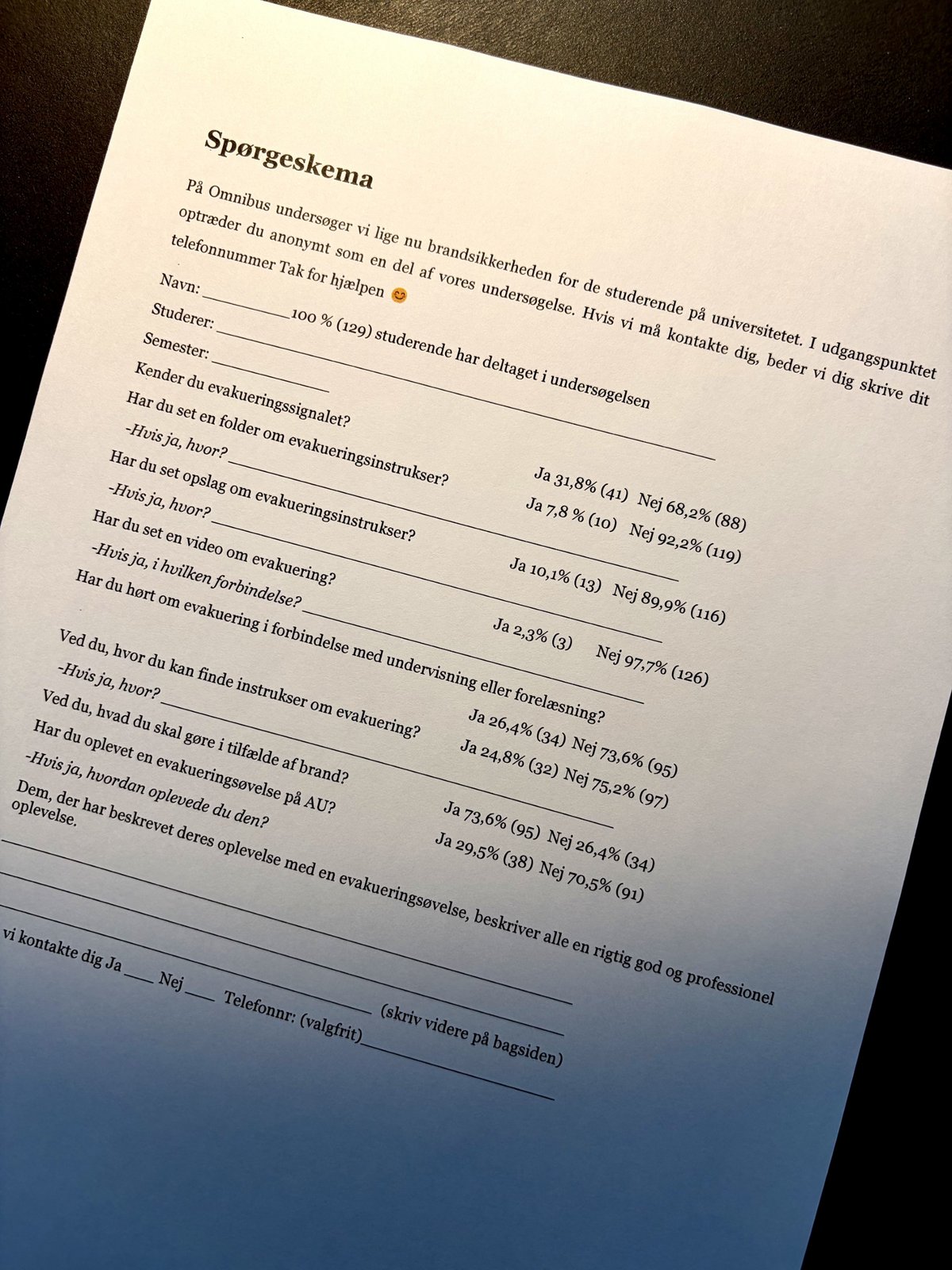
Just over 30 percent know what it sounds like when a building needs to be evacuated. 25 percent have heard about evacuation procedures in connection with teaching or lectures. About 10 percent have seen a leaflet or a notice about the evacuation procedure, and only just over two percent have seen the university's video about evacuation.
How we did it
Over the past few weeks, we at Omnibus have been working a lot on fire safety in the university's buildings.
We have told you about fire safety problems in four buildings in the Nobel Park for two decades. And we have told you that there’s a big difference between how employees are notified in the event of a fire, for example, depending on which building they work in.
In the days leading up to Easter, we asked 129 students what they know about the emergency response on campus in Aarhus. The questions are based on the student information regarding evacuation available on AU's website.
The fact that the students don’t know much about how the emergency response system is structured, or know about the evacuation procedures, doesn’t surprise the university's emergency response coordinator, Anders Kragh Moestrup. Because it’s not the ambition that students should know how evacuations should take place.
"We always work with a risk calculation in relation to how many resources we need to allocate to information. If we had school shootings in Denmark or experienced many fires, we’d have a different level of information. But we have a low risk, which is why we primarily focus on the permanent employees with a permanent position at the university," Anders Kragh Moestrup says.
Permanent staff members need to know
If a building needs to be evacuated, the permanent staff are expected to know how to act. The first person to reach the suspended evacuation instructions must assume the role of evacuation leader and wear the yellow vest. The next person to arrive will have the orange vest and the role of assembly point manager, and thus the responsibility for ensuring that the evacuees gather at the assembly point.
While the permanent staff members are expected to know the procedure and practise it every year in connection with evacuation exercises, the students aren’t expected to know about the procedures.
Therefore, emergency coordinator Anders Kragh Moestrup isn’t surprised that only 30 percent of the students know the evacuation signal.
"There are many different buildings and many different warning methods. It's hard to explain to the students," the emergency coordinator says.
Fire protection: Employees feel they are being treated unequally
Only 10 percent of the students in the survey answer that they have seen notices or leaflets about how evacuation should take place. According to Anders Kragh Moestrup, this is primarily due to the fact that leaflets and notices have largely been replaced by digital information.
Clear potential for improvement
It’s more problematic that only one in four students has heard about emergency response and evacuation in connection with teaching or lectures. And that only two percent have seen the university's own film, which explains what to do if it becomes necessary to evacuate an auditorium or a building.
"There is a clear potential for improvement. There is simply almost no one who has seen the video among students. I’d like to see it shown to a greater extent in connection with lectures or teaching in the auditoriums. Both for the sake of the students but also for the sake of the teacher," Anders Kragh Moestrup says, referring to the fact that it’s the teacher's responsibility to evacuate the classroom.
The video is available at, among other things, YouTube, and it is ready to play, but even though the idea is that the students will be presented with the video at regular intervals, it’s currently up to the lecturers whether this happens or not.
Just like in an airplane
AU has an evacuation concept that applies throughout the university. Both in Aarhus, Viborg, Herning, Emdrup, Roskilde and Slagelse. As a new employee at the university, a review of the evacuation concept is part of the introduction.
This also includes the university's own film on emergency response and evacuation, which is available in both Danish and English. The emergency response coordinator can well imagine that the use of the film will be more systematised.
"Just like in an airplane where you see safety instructions before departure, it could make sense to show our evacuation video before a lecture or teaching in larger groups. Maybe it's a little annoying, but you make sure that everyone knows what’s going to happen if it suddenly becomes necessary to evacuate," Anders Kragh Moestrup says.
As a rule, evacuation drills are held in all the university's buildings once a year. Here, the procedures are tested, which primarily permanent staff members are expected to know.
"But of course, it also involves students, depending on where the evacuation exercise takes place. Especially in areas such as auditoriums or canteens, the exercises will involve students," says Anders Kragh Moestrup, who also says it’s expected that around 30 percent of students have experienced an evacuation exercise, while 70 percent haven’t.
Most students know what to do
And then he notes that among students who have experienced an evacuation exercise, there’s primarily praise. In the survey, eight students have elaborated on their experience with an evacuation exercise, and only one has had a less good experience.
While knowledge of the evacuation procedures is relatively low among the students in the survey, three out of four answer that they know what to do if there is a fire.
That number pleases Anders Kragh Moestrup.
"It shows that most people know what to do. It’s important that everyone gets out of the building safely," he states.
If the building you’re in needs to be evacuated, you will be alerted. Either by a voice in a loudspeaker, a bell, a megaphone or by shouting. After this, you must leave the room and the building calmly and safely via the escape routes. If you are in doubt, the evacuation manager can help you. The evacuation leader is known by the yellow vest. After this, you must follow the other evacuees to the common assembly point and await further instructions.
This text is machine translated and post-edited by Lisa Enevoldsen.